Monday, March 23, 2015

Two cameras for a lens - Voigtländer Inos I

Last November I got a Voigtländer Inos I at a fairly low price. I decided to get it mainly because of the lens, an early Voigtländer Heliar f/4.5. I already have such a lens on my Voigtländer Rollfilm 5x8 and I am deeply in love with the very unique pictures that it produces. Unfortunately, the relatively exotic 127 film format that the Rollfilm 5x8 requires is not very convenient: film choice is very limited and the prices are on the high side. For this reason, I thought a 6x9 folder using 120 film (readily available in a decent variety of films at reasonable prices) with a Heliar lens was a good idea.

I was not able to check the camera in person before I got it. I could just look at a single low-quality picture, enough to see that the lens was in fact a Heliar but not much more. As the camera arrived and I opened up the package, the camera turned up to be in quite poor condition: leather was missing from the front and sides, rust had found its way onto many spots, sports and wire frame finder were not there and it felt like it had not been taken care of in the last sixty years. The lens, though, looked pretty clear, which was the whole point of it. I improvised a crude "leather" covering and got the thing running again.

crude camera covering job... #diy #electricaltape #vintagecameras #voigtländer

A photo posted by tonicito (@tonicito75) on


The shutter though, showed quite a strange behaviour: slow speeds were a little too slow, which is common because of hardening lubricants in the mechanism, but time and bulb settings, in which the shutter can be opened and closed manually through the release lever, would not respond at all and 1/250, the shortest speed, sounded and looked to me more like 1/50 or 1/100. This called for a closer inspection, so I carefully opened the shutter and discovered that a number of important pieces were missing: the B-lever, which connects the shutter release to the blade operating ring for T and B operation, was nowhere to be found. This could still be OK, since these are speeds that are rarely used except for long exposures. Unfortunately the booster spring was missing, too. This is one strong coiled spring that gives the shutter the extra tension needed to achieve its highest speed, a tension which is very noticeable when cocking the shutter at 1/250. Without the highest speed, I needed to stop down the iris to compensate, and "large" apertures (we are still talking f/4.5, so were the figures in the 20s-30s) is a favourite spot for me using a Heliar.

I accepted the facts, shot a roll of film with the camera and shutter as they were, fell in love deeply (again!) with the Heliar lens, and let it sleep. In the background I searched for a similar 6x9 folder with a compatible Compur shutter to obtain the missing parts, or to exchange mine, but found nothing. Last month, though, I did find such a 6x9 camera. And, ironically, it was yet another Voigtländer Inos I, in much better condition, and again with a fairly low price tag. This one sported an Anastigmat-Skopar f/4.5 lens which, for all that matters, is an excellent performer. It is no Heliar, though.

... but that #Heliar lens is oh so wonderful! #diy #vintagecameras #voigtländer

A photo posted by tonicito (@tonicito75) on


The shutter on the second Inos has all its parts in place. The camera has even the body piece of the sports finder which, incidentally, proved that it was indeed the relatively rare Inos I for dual format (6x9 and 4.5x6) and not the much more common Rollfilm 6x9. The shutter required a little service because the slow speeds would run much much too slow. The booster spring needed attention, too, because sometimes it fell out of position when tensioning and let 1/250 run like 1/50 or so. A little pressure, lovingly applied with pliers, brought it back to a shape with which such out of position accidents seldom happened. I need to tension 1/250 with buttery fingers, though; I hope I'd manage to notice when the booster spring falls out of position when tensioning the shutter!

Both lenses having the same focal length (105 mm), the easiest way was to replace the lenses and use this nicer camera with its working shutter. I removed the Skopar lens from the "new" Inos and replaced it with the Heliar. The threads might not have been "exactly" compatible, since the front element needed a fair amount of torque to screw, but I checked infinity focus and it looked tack sharp. The first roll of film is in the making, I hope it turns out OK.

It is interesting that both my Inos I cameras are not at all very far away in time from one another. The Inos I (back then it was just called Inos) had a relatively short production run, from 1930 to 1933 (some sources say 1932), and it was quickly superseded by the Inos II. I would say both cameras were built in the same batch: their body serial numbers are just 48000 numbers apart (I guess these body serial numbers applied not only to this model but to all Voigtländer models, but I am not sure). The battered one has a higher body serial number (947270) than the nicer one (899432). Interestingly, though, both lens and shutter were a little newer (higher serial number)in the battered one. The lenses are only 747 numbers apart (760623 for the Skopar, 759876 for the Heliar). Both point to September 1933 as fabrication date. The shutter serial numbers point to 1933, too, and again the nicer Inos has a slightly newer one.
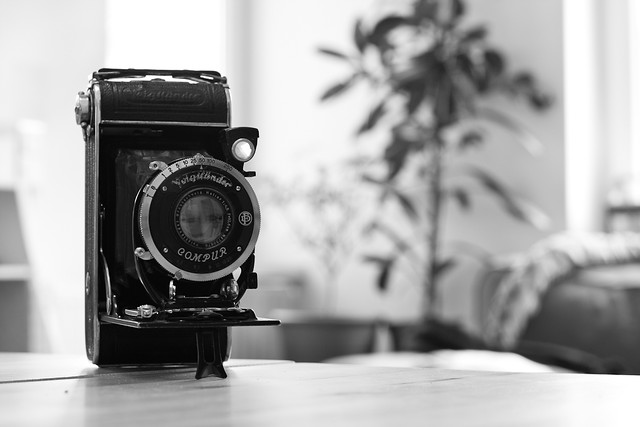
voigtländer inos i

I am happy with this camera: It is hardly possible to get a larger film format (6x9 on 120 film, that is more than six times as much area as provided by a standard 35mm camera) in a package that fits into any coat pocket so nicely as this one. The folded camera is not heavier or bulkier than the average cell phone that we used to carry around by the end of the 90s. Also, being a true Voigtländer, the quality and precision of every single component is exquisite, and its more than 70 years of various adventures are hardly noticeable when the folding bed closes nicely with a reassuring snap or the film advance key rotates as smoothly as it did in the mid thirties. And the Heliar, ah, that magical Heliar now in a much more usable package, is the whole reason why I took care of these two cameras, these almost twins that, after a long journey, reunited again.

Voigtländer Inos I
My Voigtländer Inos I flickr set

Maker Voigtländer
Model Inos I
Type folding bed camera
Lens Voigtländer Heliar 105mm f/4.5 (No. 759876, Sep 1933)
Shutter Compur, rim set, size #0, 1 - 1/250 + B + T
Film type 120 6x9, 4.5x6
Year 1933
Country Germany

Monday, March 16, 2015

Series - storefronts

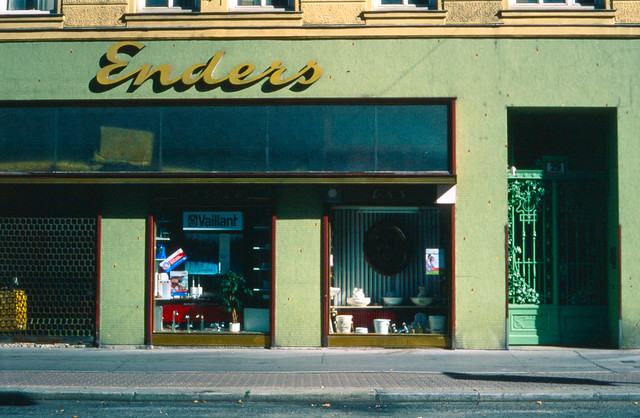
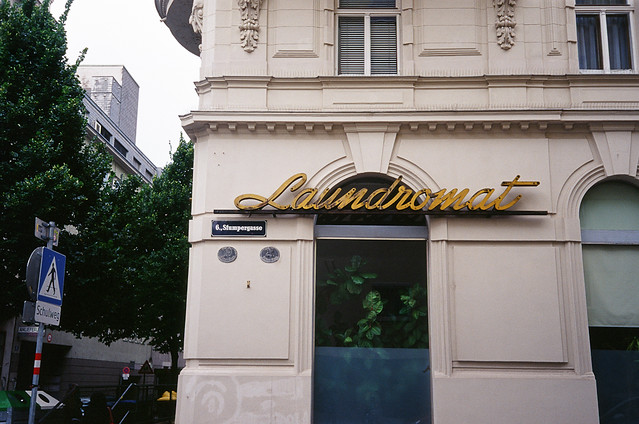
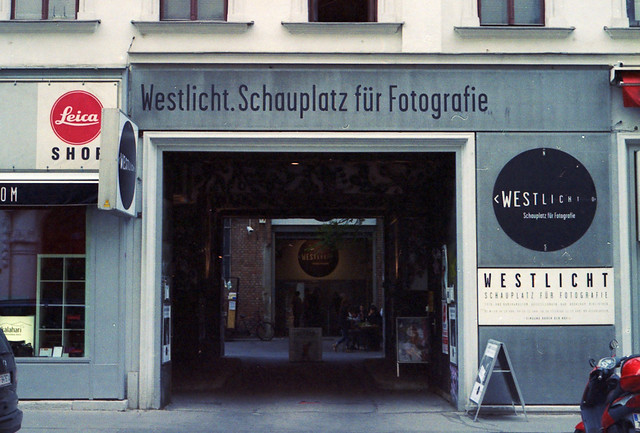
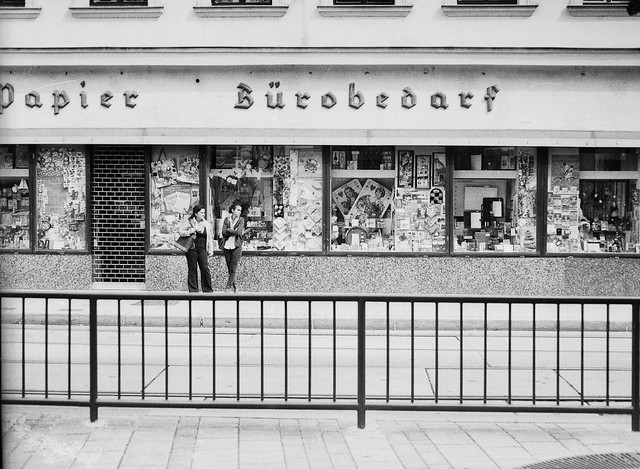
One of the first things that met my eye after moving to Vienna was the rich and interesting amount of typefaces, signs and lettering of its various shops. In fact, I already posted a weekly series about them. Of course, after that I kept finding and photographing lots of interesting signs. This weekly series is about several storefronts in Vienna.

I decided to post this new series because I wanted to tell you about the wonderful photographic project that two friends of mine (Martin and Philipp) are undertaking: Wiener Geschäfte mit Geschichte, a huge compilation of storefronts, captured on pictures forever. They recently reached their 100th storefront.

Life keeps going at an ever accelerating pace, and for me it is very important to stop, take a breath and look at the sides of the road, because the most interesting things tend to happen there, on the invisible background. For this reason I think such projects like Philipp and Martin's are important.

Hope you enjoy Wiener Geschäfte mit Geschichte and my weekly series! :)

enders
(Exakta Varex IIa, Fujichrome Velvia 50, expired, ISO 50/18°)

mittagstisch
(Contaflex IV, Solution Super VX 200, expired, ISO 200/24°)


laundromat
(Kiev 4, Kodak Elite Chrome Extra Color 100, ISO 100/21°)


westlicht
(Contaflex IV, Solution Super VX 200, expired, ISO 200/24°)

buerobedarf
(Bergheil 6.5x9, Ilford HP4, expired 1980, ISO 400/27°)

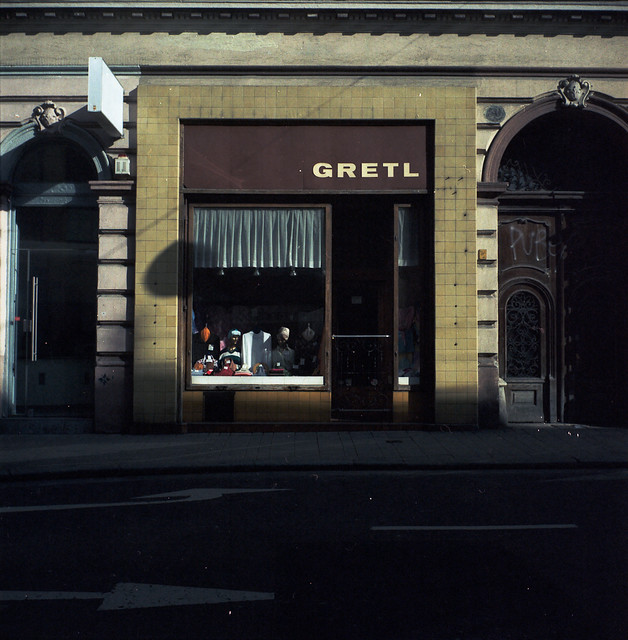
gretl
(Rolleicord I, Kodak Portra 160 VC, expired, ISO 160/23°)

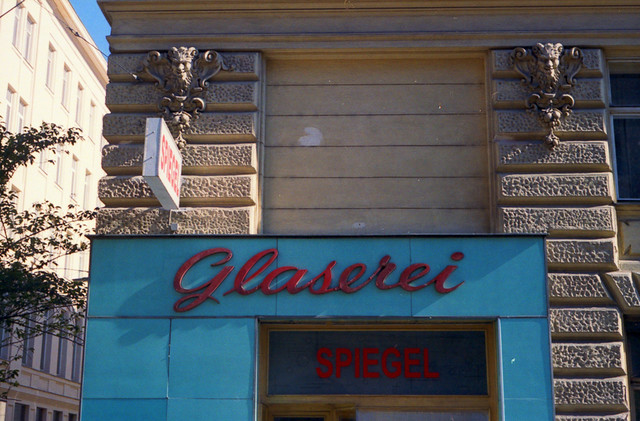
glaserei spiegel
(Contaflex IV, Solution Super VX 200, expired, ISO 200/24°)


Tuesday, February 10, 2015

A Year of film Sundays 2014 :)

On Sunday January 12th, 2014, I took the first picture of my first 52-week series: A Year of Film Sundays.

amtshaus
(Voigtländer Bessa 6x9, Ilford FP4 Plus 125, ISO 125/22°)

The idea was simple: take a film picture each and every Sunday for a whole year and (try to) post them each and every Sunday for a whole year. Of course, a couple weeks delay needed to be taken into account for development and scanning.

On Sunday January 4th, 2015, I took the last picture of my series.

ginesta (52/52)
(Super Ikonta BX, Kodak Ektachrome E100VS, ISO 100/21°)

It was a very interesting experience. Some weeks I discovered myself thinking about which camera and film I would use already on Thursday, other weeks I needed to improvise a bit more. I took the opportunity of the Sunday pictures to do a little experimenting. Some of them came out fine, especially with sheet film and home development.

caseta nova (32/52)
(Kodak Recomar 33, Fujichrome Velvia 50, ISO 50/18°)

synchronicity (47/52)
(Zeiss Ikon Contax IIa, Fuji Neopan 1600, EI 3200/36°)

In other fronts it was a complete fiasco, like with Minox subminiature film: 2 out of 2 attempts came out blank! :(

epic fail :( (22/52)

I used 21 cameras, most used on medium format film was my Voigtländer Bessa 6x9 (6 Sundays) and on 35mm film both my Kiev 4 and my Contax IIa (4 Sundays each).

It is difficult to pick up a favorite from the 52 Sundays. But, if I had to, I would say 07/52 (Sunday, February 23rd, 2014) is it.

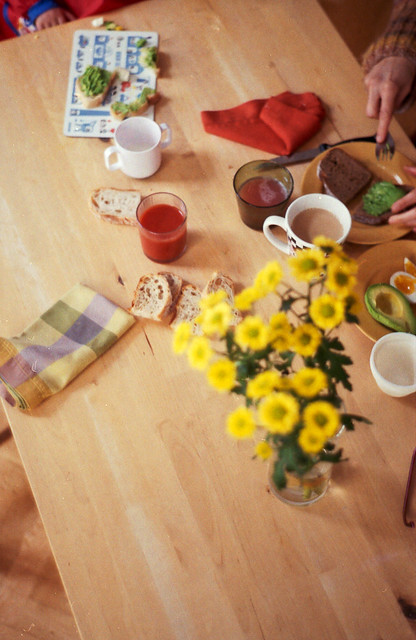
high angle breakfast (07/52)
(Kiev 4, Porst Color-X 200, ISO 200/24°)

To me, it conveys the feeling of an early breakfast on a winter Sunday before taking out our whole winter equipment and go for a hike in the woods.

Thanks for coming along with me all this year. I hope you enjoyed it at least as much as I did :)

Tuesday, December 16, 2014

Happy 4th Analogversary! (3/3)

(...continuing from here and here)

Without a doubt, this year's highlight has been the completion of my dearest camera project.

Two years ago, as I was celebrating my second analogversary, I told you about what was to be my most special challenge for the following year: the quest for a camera made in 1912, exactly 100 years before our son was born. Romantic as I am, I wanted to find one that was still able to take photographs.

One year ago, on my third analogversary, I told you about one Vest Pocket Kodak that I found here in Vienna. This camera was a good candidate, since the first production run of the original (non-autographic) model took place from 1912 to 1914. It was in surprisingly good shape, especially for a near 100-year-old camera that has seen two world wars. The camera body, though, was badly deformed and the shutter did not fire at all. I did not really see a way to make it fit for taking pictures. For a couple of months I left the VPK project in standby.

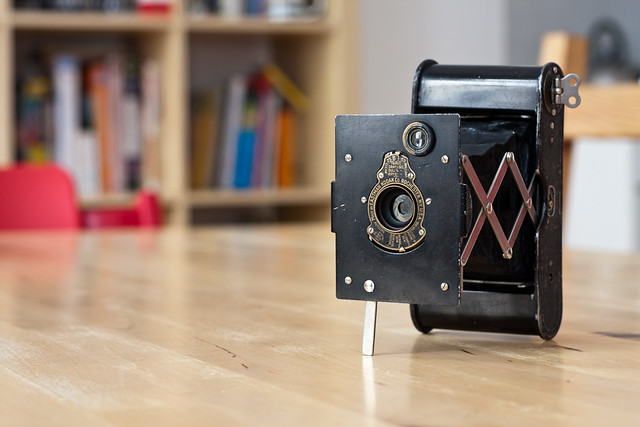
vest pocket kodak

Later this year I found another original Vest Pocket Kodak which turned out to be in much poorer condition, but had a working shutter and an intact camera body. The VPK project was alive again. After some hesitation I contacted Dr. White in the UK, whose website Collecting Vest Pocket Kodak Cameras is one of the best references that I could find about this camera model. I asked him for help in dating both of my VPK cameras. He was kind enough to recognize how meaningful this quest was to me, as he seems to share with me a passion for such endeavors, and promptly helped me with his ample knowledge. After some exciting e-mails he was able to confirm to me that, without a doubt, the first camera that I had, the one with the deformed body, came from the first production run in 1912. Square bellows, no "choke" to limit the maximum aperture and, crucially, no lettering on the front standard and no horizontal bar to help switch the waist level finder from the portrait to the landscape position were the features that pointed it to 1912. Again my deep gratitude to Dr. White for his help and for being such a key part in my 1912 camera quest.

I was very excited by this finding but still was not able to use the camera. I decided to build myself a working camera keeping as many parts of the 1912 one as I could. I exchanged the deformed camera body (in fact it is just the back: everything else, bellows, struts, front standard, shutter and lens completely detach in a block from the camera body) with the healthy one. Then I planned to mount the working shutter and lens onto the 1912 front standard but, in a touch of inspiration (with much trial and error and the minute bending of one crucially actuating lever), I managed to fix the 1912 shutter and to make its leaves open and close again. Which is fortunate, because both 1912 lens and shutter are in an almost pristine condition, contrary to the other one, which clearly shows its age. To sum up, I have now a working 1912 Vest Pocket Kodak with a back that, at the latest, was made in 1913 or 1914. This is not only the oldest but without a doubt the most special and meaningful camera that I own.

bubbles (43/52)
(Vest Pocket Kodak, Meniscus Achromat, Efke 100, ISO 100/21°)

It made me especially happy that the first pictures that I took with this camera were those of our son's second birthday, 102 years after the camera was built. After developing the film and looking at the pictures I was truly impressed by the performance of this very simple meniscus lens. The light leaks apparent in both pictures I am posting here are not the camera's fault, but mine: as I took out the exposed roll of film from the camera, the protective paper unrolled a bit and let a little light in. The camera bellows is perfectly light tight.

the photographer
(Vest Pocket Kodak, Meniscus Achromat, Efke 100, ISO 100/21°)

The 1912 Vest Pocket Kodak is not the most convenient camera to use, but still quite usable and, as its name promises, extremely easy to carry around. I used it again two weeks ago on 2nd Winter 127 Day (127 film was, in fact, introduced in 1912 specifically for this camera model!) and I am taking the 1912 VPK with me again this Christmas.

~ ~ ~ o ~ ~ ~

My plans for the next year are again collect less and shoot more. Well, not only shoot more but shoot better. I want to concentrate on using less cameras, my dearest ones, and try to take the most out of them. In this year I have the feeling I experimented too much: too long expired films, too extreme lighting conditions, too many poorly thought pictures shot hoping that they would come out fine. Most of them didn't. I wish to be able to take a little more time and consciousness in the picture taking act. I know I already have fine cameras and lenses, very capable of delivering quality. The weak link in the chain is now the photographer. I also want to concentrate on less films, the ones that worked best, and try to make the film choice a conscious picture taking decision at the same level as are framing, composition and depth of field.

I want to keep on doing my own repairs. Working on my cameras not only makes me strangely happy but also makes me know them a lot better. I (begin to) deeply understand what happens as I cock the shutter, as I advance film, as I change shutter speeds, inside many of my cameras. And this knowledge is gold for the times when things do not work properly. I really wish I manage to make the shutter in my Contax II work, since I have the gut feeling this camera could be the one to which I will always be returning.

I want to extend my developing skills beyond black and white. I am going to research the feasibility of developing color negative (C-41 process) and/or color slide (E-6 process) film at home, because I keep reading that it is not harder than black and white development. And, yes, I still find this caffenol development thing very exciting... :)

And, of course, I want to find more time to write about my photographic challenges here in my blog. I hope you'll keep on sharing this journey with me! :)

Monday, December 15, 2014

Happy 4th Analogversary! (2/3)

(...continuing from here)

One of my wishes for this fourth year was something in the lines of "collect less, shoot more". Well, the "collect less" part did not really come out very well, but I am happy to see that I did manage to shoot much more film than in the previous year. I shot 81 rolls/sheets of film in this year, which is almost as much as I shot in my first analogic year. Comparison with last year (32 rolls total) makes me quite happy. The cameras that I used the most have been the Kiev 4 in 35mm film (12 rolls) and a tie of the Bessa 6x9 and the Super Ikonta BX in 120 film (6 rolls each). This year I shot 5 rolls of 127 film, which is an all-time high. The Vest Pocket Kodak, one of the 127 cameras that I used, will be the main topic on my third and last analogversary post...

About the films that I used the most there are two old friends and a new kid on the block: in black and white I shot 4 rolls of Kodak Tri-X 400, most of them pushed even to EI 3200 (3 stops) which came out fine and contrasty, and in color slide again the winner was Fujichrome Velvia 50 with 6 rolls and 2 film sheets. In color negative I shot 7 rolls of an expired Porst Color-X 200, which I suspect is rebadged Kodak material, with a color rendition, especially in sunlight, that has grown on me along the year.

in the spotlight (20/52)
(Vitomatic IIa, Color-Skopar 50mm 1:2.8, Porst-Color-X 200, ISO 200/24°)

This year I shot a lot of sheet film using plate cameras: 6 sheets in 6.5x9 format (using both my Ideal 250/3 and my Bergheil 6.5x9) and 7 sheets in 9x12 format (with my Recomar 33). Again, there is great satisfaction in holding a huge 9x12 color slide sheet against the light and marvel at the level of detail that it can capture.

Another challenge that became a routine this year has been black and white film development. I developed 17 rolls/sheets of diverse brands of black and white film, all using the same film developer (Rodinal, in fact the oldest photographic product, still being produced after almost 125 years!) and mostly using stand development. There have been mixed results, the great part quite satisfying and some not so much. But I guess the not-that-happy ones were more about using very long expired film in poor lighting conditions than the development.

long toddler exposure
(Kiev 4, Jupiter-8M 50mm 1:2.0, Efke 25, ISO 25/15°, stand development 1.5 h in 1+100 rodinal)

I love the almost meditative mood one reaches on certain film development stages, especially in the final wash using the Ilford method: filling up the tank with water and performing slow inversions for 1, 2, 5, 10, 20 and 50 times each round, spilling the water and filling up the tank again each time between rounds. After that, the magical moment of opening the tank, and slowly unrolling the wet film from the reel to reveal the pictures that were latent until the chemicalthes did their job, is every time a personal highlight.

Another highlight this year has been in camera repairs. I started with my Rolleiflex Original 611, whose shutter needed attention. I managed to recover the sticky slow speeds and make the old rim set Compur shutter purr again happily even at 1 second. I, too, cleaned the optical path (inner side of the viewing lens, mirror and ground glass) as well as I could, which made the camera again quite usable. At last, I managed to clean and polish its leather, realizing that the brown spots that I thought were permanent did, in fact come out and left a shiny, beautiful camera that shouts quality from all its four corners. The Voigtländer Brillant V6 was a camera that I almost recovered to working condition from the trash can. I got it as a cheap addition to a lot (together with a Rolleicord V). Being a Voigtländer, even with a bakelite body, it is a well built and extremely well thought camera that responded very well to a little care. I fixed the film transport with film counter and automatic stop, and cleaned the waist-level finder and mirror to a crystal clear state I still can not believe. The Skopar 75mm 1:4.5 lens and the Compur shutter needed cleaning and service, too. All in all, I got lots of camera repair fun and a portable, usable camera that delivers a quality that is difficult to beat, all for what you would pay for a lunch in a standard restaurant.

The Ihagee Parvola 1350 needed, as usual, a little service in its Compur shutter. In this shutter I braved removing the slow speed escapament for the first time for properly cleaning it. It was my first time because on reinstallation one needs to adjust the shutter speeds again, because the position of this escapement determines the duration of the slow speeds. It was not easy, but at the end all speeds sound and look good enough for me. The Schneider Xenar 70mm 1:4.5 needed a little cleaning, too, and I lubricated the focusing helicals to make them run smoothly. Another first for me was adjusting a rangefinder: my Kodak Retina II needed a little lubrication and cleaning in the rangefinder, and after that the infinity setting needed to be adjusted again. I am still not quite sure if I got it right, I still have to check with critically focused shots, but it looks now clean enough to be used.

happy 4th analogversary!

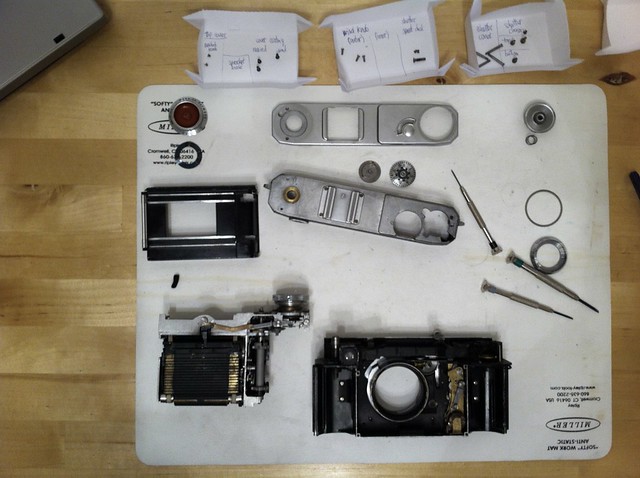
My biggest repair this year, though, is still a work in progress. The Zeiss Ikon Contax II, one of the best cameras ever made and one that I am really happy to own. As I got it, neither the self timer nor the shutter did work. The Contax has a metal curtain focal plane shutter, a quite different beast from the leaf shutters that I am now quite familiar with. I opened it carefully and disassembled to shutter block from the camera body. A little cleaning, a little help and I managed to make it run a couple of times, with a purring and whizzing sound from its multiple escapements that made me think for a moment that I was about to succeed. But then the bane of this camera model set off. The Achilles' heel of every prewar Contax, and in fact the only thing that ever fails with a Contax, are the silk shutter ribbons that link together the opening and closing curtains. The shutter design is such that the ribbons slide through tiny eyelets on the opening curtain that have enough friction to hold it up as the shutter is cocked but allow sliding through when the shutter is fired and both opening and closing curtains are reeled onto the lower drums. These ribbons needed to be replaced every ten or twenty years, cameras were guaranteed for around forty thousands shutter operations. A camera that was built in 1936-1937, like mine, and that probably has been sleeping for decades, has had plenty of time for these ribbons to become dry and fray. Two or three shutter operations in my hands after such a long time was definitely too much for the old silk ribbons, that broke and left me with a much more serious repair job to do. Because, of course, these ribbons can be replaced. I already got the replacement silk ribbons from Japan (it seems to be one of the few ribbon type and material that properly work on a prewar Contax) but I still did not find the courage to delve again into the job. The Contax II shutter remains my biggest camera repair challenge for the next year. And if I manage to fix the non-working self timer along the way, I will be twice as happy.

The last successful camera repair job this fourth year has been a Vest Pocket Kodak from 1912, my oldest and most significant camera so far. The whole story of the Vest Pocket Kodak, on my last analgoversary post, coming soon...

(to be continued...)