Showing posts with label film. Show all posts

Sunday, December 11, 2016

Happy 6th analogversary!

On December 11th 2010, six years ago, I posted my first film picture on flickr. I took it with a (then) 50 years old Kodak Retinette IA that my mother-in-law gave to us, the first old film camera that I used after some years of digital photography.

These days I have been thinking a lot about what it is that kept me doing what I do (photographically speaking) these last six years. I concluded that, for me, film photography is just the medium, but not the goal. Although I like pictures on film very much, I realized that it is not just about film. In fact, I am not really interested in using any last generation film SLR camera from the late 90s, which would arguably be the easiest and most practical access to film photography nowadays. What I really do enjoy is to take pictures with old cameras. That is my passion. The fact that such cameras do need film is just a happy coincidence. One that makes my commitment to film grow strong.

How old is "old"? Well, I cannot give a definite answer to that question: it depends on the camera. Generally speaking, a full-mechanical camera (no electronics, no batteries) made sometime between the early 20s and the late 70s of the past century can be interesting to me. But I do have (and use) a couple of cameras that are both older (1912) and younger (1989) than that. And not every camera from that period (there are thousands!) makes my heart skip a beat.

There have been few new cameras in this sixth year. For a couple of months I have been busy elsewhere and, in a sense, my old camera passion did recede a little bit on the first half of the year. Mostly because I have been distracted by bicycles. Especially older ones, as it could not be otherwise!
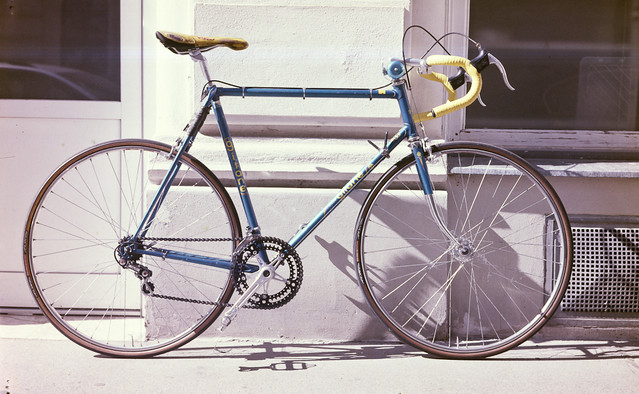
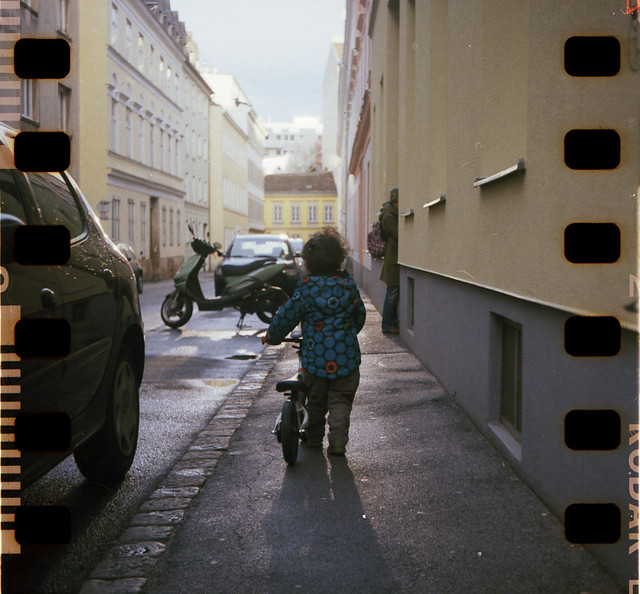
gitane
(Bergheil 9x12, Kodak Ektachrome 200 EPD, expired, ISO 200/24°)

There have been, quite unconsciously and mostly due to good luck, a couple of "redundant improvements" to my photographic stable. With this I mean cameras or lenses that I already had, this time in a new (and, to me, more desirable) fashion. I have long had a 1962 Exakta Varex IIa, the model with the name EXAKTA in block letters over a black background. This year I found another Exakta Varex IIa body, a little older (1957), with the more elegant engraved lettering on the front. Or a 1953 Zeiss Ikon Contessa 533/24, which I already have since 2012, now in a much less battered state and the rare matching leather case. The fact that I have this Contessa as a backup makes me less fearful of tackling with the repairs that my first Contessa needs (frozen slow speed escapement, rangefinder adjustment). Another very lucky strike made me the proud owner of a 1938 Voigtländer Bessa RF, in quite good condition and an intact yellow filter. It sports the most desirable Heliar f/3.5 lens. I already have a Bessa RF with a Skopar lens, which is nice and sharp, but is no Heliar. A couple of Zeiss Ikon Contaflex I, because the lens on them, the coated 45mm f/2.8 Tessar from West German Zeiss, is one of my favorites (it is the one that the Contessa has as well), and I could not resist a camera that allows looking directly through that lens. And finally, a rangefinder 1954 Kodak Retina IIc because it is a kind of bigger sister to our Retinette IA, the one with which everything began.

In this year, too, I managed to get some practical accessories for many of my cameras: leather cases, a 9x12 roll film back much more convenient than the one that I already had, a prism viewfinder for my Exakta Varex IIa and a Leitz VIOOH/Imarect universal external viewfinder for my Leica IIIa, just for the sake of it, because I still have only one lens on Leica screw mount. Ouch, that nasty collector in me... ;)

This year I shot less films than the previous one. There have been 11 rolls in black&white, from which the most shot was Kodak Tri-X 400, then 15 color negative rolls, Kodak Portra 400VC being the one I took most often, and 13 color slide films, from which, surprisingly, the one I shot the most was Kodak Ektachrome 64T in 9x12 sheet film format. A Kodak year, so to speak.
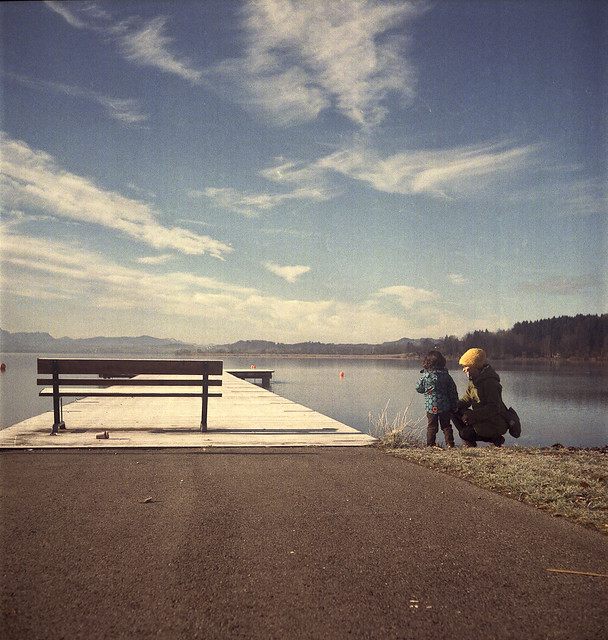
sunday
(Rolleiflex 631, Kodak Portra 400VC, expired, ISO 400/27°)

The camera I took most often was my Rolleiflex Automat 631 (8 films), followed one more year by the Contax II (6 films) and, quite worth mentioning, the Bergheil 9x12 plate camera with sheet film (4 sheets).

I am happy that this year I found the strength to keep servicing and repairing my cameras. Even though I took it again after a long pause just a couple of months ago (as I said, I have been busy/distracted servicing and repairing old bicycles), I found again excitement and peace in delving into the depths of a number of cameras and shutters.

My Rolleiflex Old Standard 621 was in need of some attention after having been a little neglected the last years. I carefully cleaned both lenses, which had gotten a little foggy, and dismantled the whole waist-level finder to clean the viewing system as well. I hoped to find the exact fabrication date of my camera hand-scratched behind the mirror, but unfortunately I found nothing. I managed to secure the flaps of the waist-level finder hood, which had always been a little shaky and never closed perfectly. Now the hood closes with a reassuring snap every single time. I managed to fix another of my Rolleiflexes, the Automat 631, as I already explained a couple of weeks ago. I am happy to report that the film transport mechanism operated flawlessly through the first film that I shot after the repair.
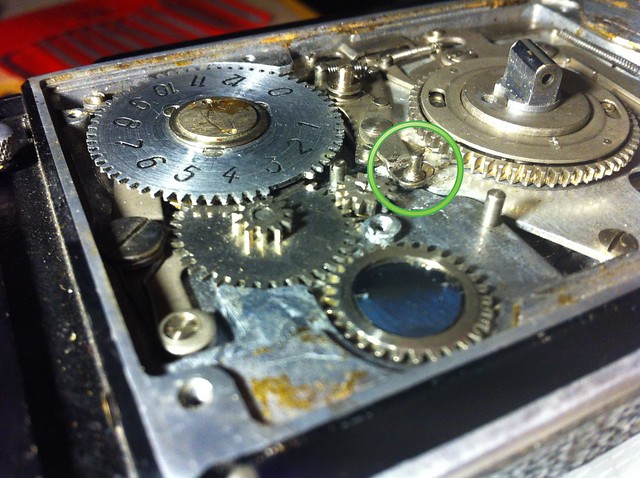
Rolleiflex Automat 631 - Dowel in place

My still dormant Zeiss Ikon Contax S got a new set of shutter curtains but, alas, that did not solve the erratic locking of the wind mechanism that happens from time to time. Still a work in progress. As well as the aforementioned Zeiss Ikon Contaflex I, whose diaphragm stops down a little too slowly resulting in overexposed pictures. It needs a bit of lubrication in the aperture ring, or maybe a little more tension, or probably both.

As you see, I have still lots to do in the servicing & repair chapter. I hope I will find the time, inspiration and strength to keep going on.

One of my photographic realizations last year was how nice it felt to be able to create memories, what a warm feeling it is to look at pictures of my family, of my friends. The strongest motivation that I have to grab a camera is, still, to take a picture of my loved ones.

This year started with our family growing, we welcomed our second son in January.
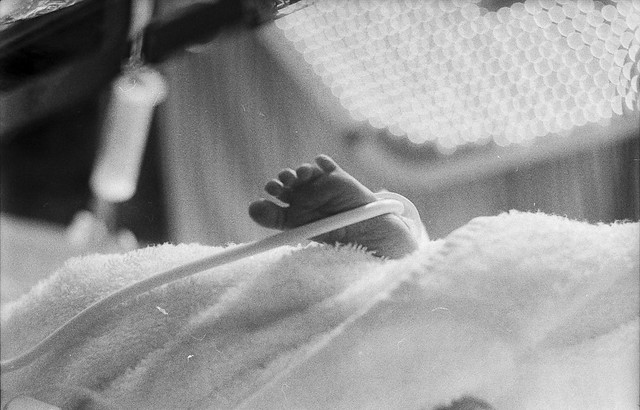
nicu
(Contax F, Kodak Tri-X 400, EI 1600/33°)

After a very challenging first month, in which photography was one of the few things that helped me keep my sanity, that brought me peace and solace, the inspiration slowly returned, and I managed to find happiness and enjoyment in creating such memories again.

kissed by the sun
(Exakta Varex IIa, Fujichrome Velvia 50, expired, ISO 50/18°)
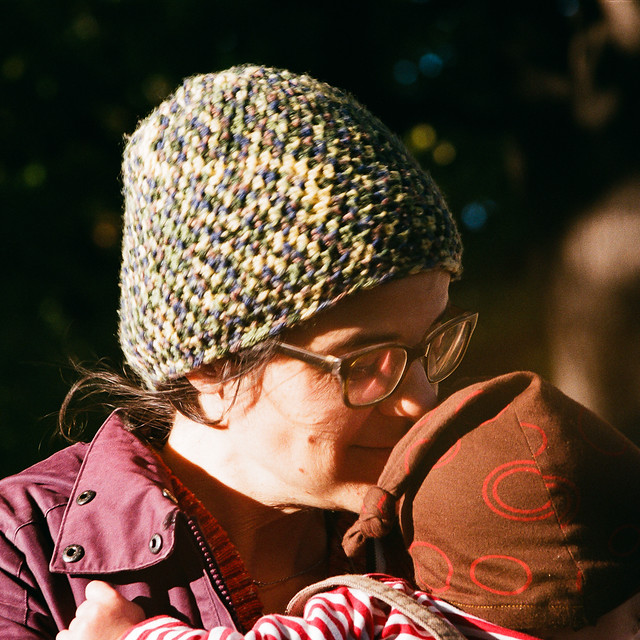
double portrait at sunset
(Contax II, Porst Color-X 200, expired, ISO 200/24°)
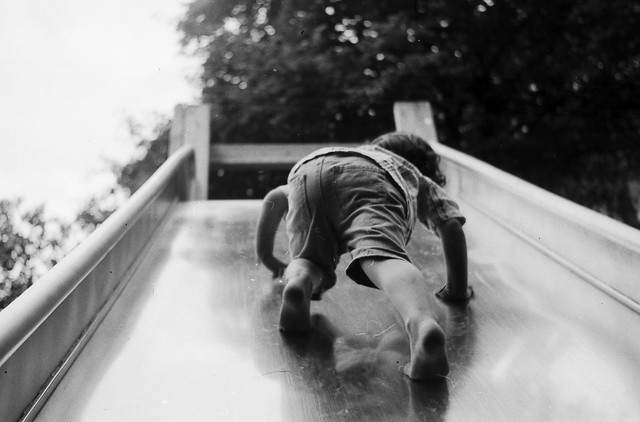
climber
(Contessa 533/24, Ilford Delta 100, expired, ISO 100/21°)

And this, for me, is a very important endeavor. I have become very aware of the invisible but yet very real border that a child's memory cannot cross. My older son is able to recall easily, and with a surprising richness of detail, events that happened a year and a half ago. Yet, he cannot remember anything that happened before he turned 2 (he is 4 years old now). Neither single events, nor "bigger" things like how our flat looked back then. In the light of this, I have come to understand my pictures of them as a kind of poor, but still necessary, additional memories for my children, from a time in their lives that they are probably going to forever forget. I am happy to do this for them. I consider myself very fortunate.

As I did with my older son, ever since I knew my second son was going to be born in 2016, I started my search for a camera, an old one, made in 1916, a camera exactly 100 years older than him. Romantic as I still am, I want it to be able to take pictures. I thought that 1916 was not going to be as difficult as 1912, but to this day I have only one single candidate that could have been built 100 years ago: an Ansco Vest Pocket No. 1, which I got in my previous 1912 quest. The camera, though, is still not usable, because the bellows is badly worn and not light-tight. I was able to recover operation in the 100 year old Actus shutter, but unfortunately, I managed to destroy the diaphragm in the process (an aperture blade broke). I still could operate the camera always at full aperture, but there is still the leaky bellows problem.

I guess, thus, that the quest for a camera made in 1916 is still open. Hope dies last, and I am already longing to get a 1916 Voigtländer Alpin. In any case, I will be honored if you keep sharing this exciting journey with me.

Friday, December 11, 2015

Happy 5th analogversary!

Five years ago, on December 11th 2010, I posted my first film picture on flickr. These have been definitely the most exciting years of my (short) photographic adventures.

For me, it all boils down to a fascination with simplicity, to the quest for a minimalistic picture taking setup. Film has been liberating in many aspects. No more coming back from a short excursion with 200+ digital pictures to find out that I have neither the time nor the willingness to process and sort them out. No more forgetting about spare batteries or memory cards. No more search for total picture perfection. I think we humans tend to overdo a bit: we wanted music perfection and along came high fidelity and digital audio to deliver just that. Then we realized that perfection was almost akin to lack of "soul", that what we actually loved was the background scratching noise of the good old vinyls. We asked for picture perfection and along came a herd of engineering and electronic wonders able to deliver just that. Still, we realized perfect pictures did not deliver the emotional response we were used to. On the other hand, film did just that for years, and still does. And here I am.

There have been many new old cameras this year. Each and every one with a certain meaning or purpose. But, in many cases, the collector has won over the photographer. There are certain sequences, certain regularities, certain historically significant milestones, that I now recognize as quite valid reasons to purchase a camera, although from a user point of view it has little or no added value. This year, as I will explain in a minute, the collector in me has been driven almost exclusively by a single word: Contax.

I am very happy after this fifth film year. When I look back at the pictures I took this year, I realize that I definitely grew up. There is a gut feeling about exposure, there is a familiarity with certain films, with certain lenses, with certain cameras, that is new and very reassuring. Of course I make mistakes every now and then, but this year there are a number of pictures that I am quite proud of. Last year I felt the photographer was the weak link in the chain. It still is, but I am happy to realize that I am working on it.

toy car time
(Contax II, Solution Super VX 200, expired, ISO 200/24°)

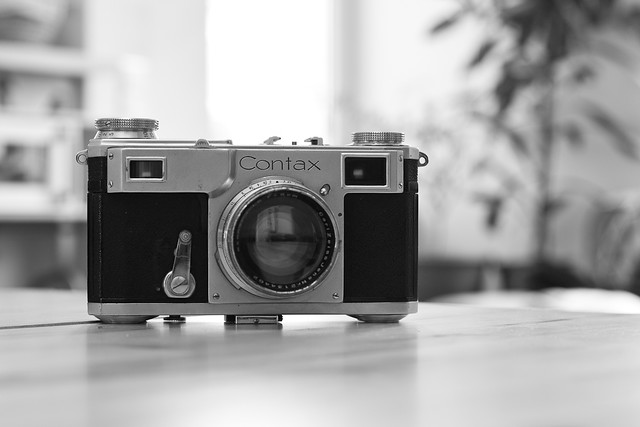
The year started with an ongoing fascination for Contax rangefinders. Through active scouting and a couple of good luck strikes, I am now the proud owner of an almost complete lineup of Zeiss Ikon Contax 35mm rangefinders: both prewar Contax II (1938) and Contax III (1938) and postwar Contax IIa (1952) and Contax IIIa (1950-1951). The only one missing would be a Contax I, the first one introduced in 1932. They command prohibitive prices and have a reputation for being mechanically fragile. The collector in me is on the look. The user keeps telling him there is no hurry. These four cameras have been the ones I most used this year: 25 films in total, 10 alone with the Contax II. As a nice counterpoint to the Contax family, in late summer came along their arch-rival, the measure of all things, a wonderful Leica IIIa (1936).

zeiss ikon contax ii

This rangefinder love story has not been just on 35mm film, though. I already owned Super Ikontas for 6x6 and 6x4.5 format on medium format 120 film. A relatively battered but functionally sound Voigtländer Bessa RF (1939) arrived to cover the wonderfully large 6x9 format with the reassurance of a rangefinder to set the focus distance right. With the unforgiving shallow depth of field of the 105mm lenses normal for this format, this is truly a great help. Again the Super Ikonta BX (6 rolls) and this Bessa RF (5 rolls) have been among the medium format cameras that I used the most this year.

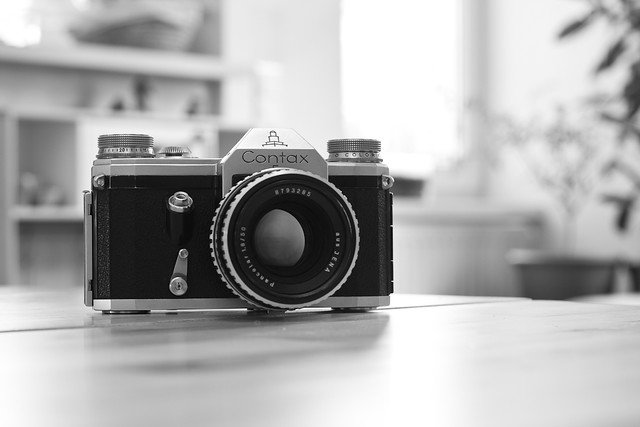
Another interesting turn this year has been the (re)discovery of 35mm SLR cameras. Again, it all started with a Contax, but now the East German one, the first camera with a fixed pentaprism, the one that laid out the design that every single SLR camera followed for the next 60+ years (yes, dSLRs are still built after the Contax SLR today). First a Contax F (1956-1959), then a very early and still non working Contax S (1950). In order to learn the skills and tricks needed to return the Contax S to working order, I acquired a number of nonfunctional Contax F/Pentacon F "test objects" for little money, with the idea of repairing them, learn a lot and then sell them away. Two of the Fs, though, are so accurate and fine after getting a new set of shutter curtains that I have trouble parting with them... One of them, probably the Pentacon F, is definitely going to stay, because this way I can use the lens that came with the Contax S, a magnificent Carl Zeiss Jena Biotar 58mm 1:2.0 that seems to transform every single picture into a work of art. An Ihagee Kine-Exakta II (1949-1950) was, again, a nice counterpoint to the Contax family, to enjoy the reversed image on its waist level finder.

contax f

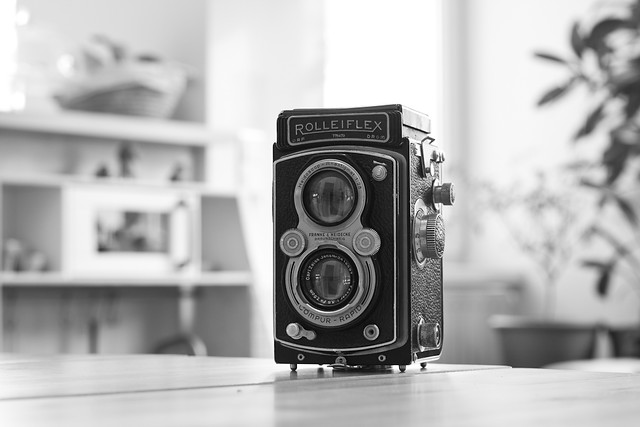
Talking about lineups and families, I could not resist an early F&H Rolleiflex Automat 6x6 (1938-1939) that came with a bunch of accessories and has been too (with 6 rolls) among the most used medium format cameras this year. The Rolleiflexes I own now are a Rolleiflex Original 611 (1929), a Rolleiflex Old Standard 621 (1935) and this Rolleiflex Automat 631 (1938-1939). See the sequence there? As I said, I could not resist... :) There is a very interesting story about the repair process of this camera, but as it is still not fully completed, I hope I will find time later on for it. It involves a missing piece that was, in fact, not missing but dormant inside the camera for decades...

rolleiflex automat 631

And finally, as the year was almost over, a revival of the venerable 9x12 sheet film format came with a Voigtländer Avus 9x12 horizontal (1925). As the online seller did not manage to open up the camera front, I got it without knowing what lens was on it or, for that matter, if it even had a lens! The price was really attractive though, so I got it anyway. As the camera arrived, I did manage to open the front and discovered a lens (Voigtländer Dynar 135mm 1:5.5) about which I did not know much. To my surprise, as I researched a bit, I discovered that the Dynar is no other than a second generation Heliar (one of my strongest longstanding favorite lenses of all time, as you can read here, here and here) that got another name to not mess with the sales and reputation of the first generation Heliar. Pictures taken with it reveal its true pedigree. Again, the story about transferring this lens to a more convenient 9x12 camera body (no other than a Voigtländer Bergheil 9x12) remains to be told soon. As it involves a certain amount of McGyver-esque use of cardboard adapter rings and had a happy ending, I hope it will be an amusing one.

When it comes to the films I used, this year has been a very balanced one (22 black&white, 24 color negative, 21 color slide). The ones I shot the most: Ilford HP5 Plus 400 for black&white, Kodak Portra 160NC for color negative and Agfaphoto CT Precisa 100 for color slide, with 5 rolls each. This year I experienced a reconciliation with long expired film. In fact, I shot much more expired than non-expired film this year. I did it, though, in a much more mindful way. I tried to adapt my shooting to the shortcomings and special needs that I learnt the hard way in the past. It is beginning to work out, I think.

red cast
(Rolleiflex Automat 631, Fujicolor HR 100, expired 1986, ISO 100/21°)

Although this year I kept developing my black&white films at home (18 rolls in total), lately I found myself being lazy and bringing b&w film to the lab for development, too. I got myself a color negative development kit, but I did not manage to find the time and the motivation to try it. I guess the need to do my development in the evening or even late at night, when our son is already sleeping, does not help, as it neither does having to store everything in the broom closet afterwards. Alas, I guess there might come a time where I am more inspired to develop.

What I kept doing, though, is fixing and servicing my cameras. This year I am particularly proud of the successful rangefinder adjustment of my Bessa RF, on which I went almost exclusively by feeling, after realizing that the only hints I found online were in fact meant to solve another issue. Another fun repair was the sticky film advance/cocking lever on a Zeiss Ikon Taxona, for which I needed an almost complete strip down to remove the hardened grease that was preventing a smooth operation. I have become relatively proficient at replacing stiff shutter curtains on East German Contaxes, although the whole point of this learning, bringing back the Zeiss Ikon Contax S to life, has not been reached yet. And not to forget the repairs that I mentioned before: first, recovering infinity focus on my Rolleiflex Automat 631 and recovering its automatic stop on film advance (still a work in progress), and second, transferring Compur shutter and Dynar lens from an early Voigtländer Avus 9x12 horizontal to a later Voigtländer Bergheil 9x12 body with Bergheil bayonet. What I still did not have the guts to tackle, though, was the one repair that I told about one year ago: replacing the broken shutter ribbons and the slow speeds on a Zeiss Ikon Contax II. I must admit I cheated a little bit on this one, since the Contax II that has become my favorite this year is in fact another (working) one which I came across. Still, the prewar Contax II is high in my to-do list.

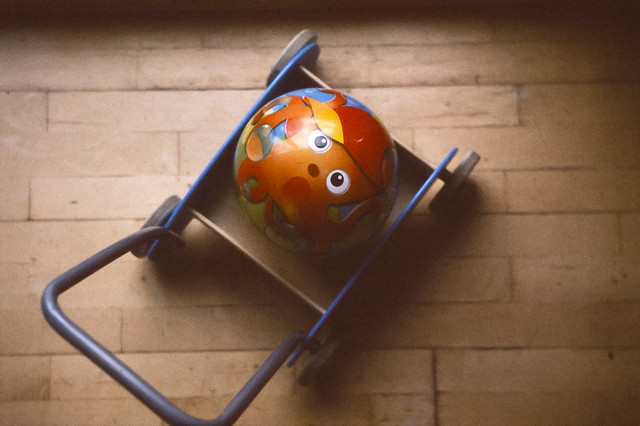
cart and ball (49/52)
(Contax IIa, Fujichrome Provia 400, expired 2000, ISO 400/27°)

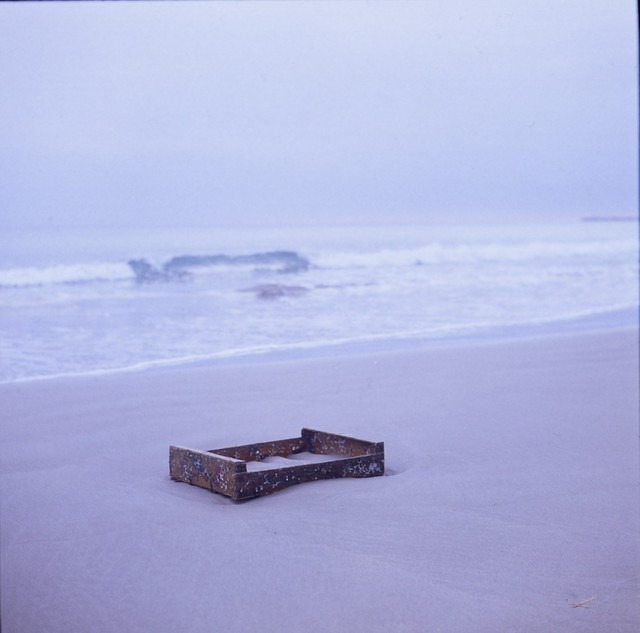
flotsam
(Super Ikonta BX, Fujichrome Provia 400X, ISO 400/27°)

As I said, I am quite happy with the pictures I took this year. About the shooting, there seems to be a deeper understanding of the naked camera and its four controls (aperture, shutter speed, focus and framing). Sometimes I realize I did not consciously think about any of them, yet the picture was taken. A long time ago, a photographer acquaintance of mine told me that "you have to know your light". Maybe this is what he meant. Like when you are riding your bicycle and you do not think about how you are steering, yet you drive safely through the corner. Of course there are differences between the cameras (focus is not the same with a rangefinder than with a plate camera!), yet I found I did not have to struggle much after taking a different one.

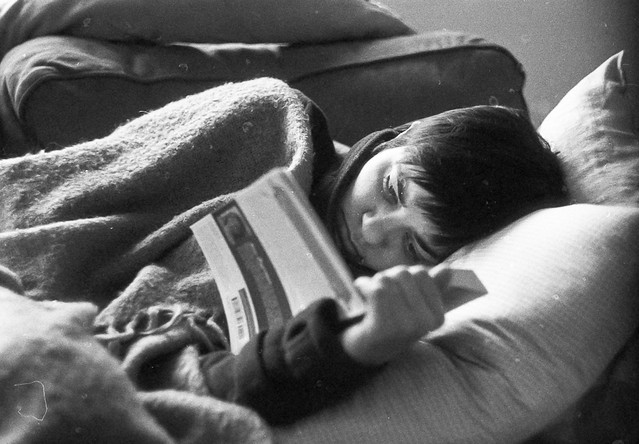
reader
(Contax F, Ilford HP5 Plus 400, expired, ISO 400/27°)

into the light
(Baby Ikonta 521/18, Kodak Ektar 100, ISO 100/21°)

For my next year I wish I manage to keep taking as many pictures as I did this last one. Because I realized how nice it is being able to create memories, the ones that reach to your soul, and what a warm feeling it is to look at pictures of my family, of my friends. I realized, too, that my strongest motivation to grab a camera is, simply, to take pictures of my loved ones. I wish, too, not to loose the direction my photography seems to be taking. I guess I am defining my photographic style, and it feels right to me.

tessar summer sunset
(Rolleiflex Automat 631, Kodak Portra 160NC, expired, ISO 160/23°)

warmth
(Contax IIa, Ilford HP5 Plus 400, expired, EI 1600/32°)

And, of course, I wish I manage to find more time to write about this journey more often than this last year. I will be honored if you keep sharing it with me! :)

Tuesday, December 16, 2014

Happy 4th Analogversary! (3/3)

(...continuing from here and here)

Without a doubt, this year's highlight has been the completion of my dearest camera project.

Two years ago, as I was celebrating my second analogversary, I told you about what was to be my most special challenge for the following year: the quest for a camera made in 1912, exactly 100 years before our son was born. Romantic as I am, I wanted to find one that was still able to take photographs.

One year ago, on my third analogversary, I told you about one Vest Pocket Kodak that I found here in Vienna. This camera was a good candidate, since the first production run of the original (non-autographic) model took place from 1912 to 1914. It was in surprisingly good shape, especially for a near 100-year-old camera that has seen two world wars. The camera body, though, was badly deformed and the shutter did not fire at all. I did not really see a way to make it fit for taking pictures. For a couple of months I left the VPK project in standby.

vest pocket kodak

Later this year I found another original Vest Pocket Kodak which turned out to be in much poorer condition, but had a working shutter and an intact camera body. The VPK project was alive again. After some hesitation I contacted Dr. White in the UK, whose website Collecting Vest Pocket Kodak Cameras is one of the best references that I could find about this camera model. I asked him for help in dating both of my VPK cameras. He was kind enough to recognize how meaningful this quest was to me, as he seems to share with me a passion for such endeavors, and promptly helped me with his ample knowledge. After some exciting e-mails he was able to confirm to me that, without a doubt, the first camera that I had, the one with the deformed body, came from the first production run in 1912. Square bellows, no "choke" to limit the maximum aperture and, crucially, no lettering on the front standard and no horizontal bar to help switch the waist level finder from the portrait to the landscape position were the features that pointed it to 1912. Again my deep gratitude to Dr. White for his help and for being such a key part in my 1912 camera quest.

I was very excited by this finding but still was not able to use the camera. I decided to build myself a working camera keeping as many parts of the 1912 one as I could. I exchanged the deformed camera body (in fact it is just the back: everything else, bellows, struts, front standard, shutter and lens completely detach in a block from the camera body) with the healthy one. Then I planned to mount the working shutter and lens onto the 1912 front standard but, in a touch of inspiration (with much trial and error and the minute bending of one crucially actuating lever), I managed to fix the 1912 shutter and to make its leaves open and close again. Which is fortunate, because both 1912 lens and shutter are in an almost pristine condition, contrary to the other one, which clearly shows its age. To sum up, I have now a working 1912 Vest Pocket Kodak with a back that, at the latest, was made in 1913 or 1914. This is not only the oldest but without a doubt the most special and meaningful camera that I own.

bubbles (43/52)
(Vest Pocket Kodak, Meniscus Achromat, Efke 100, ISO 100/21°)

It made me especially happy that the first pictures that I took with this camera were those of our son's second birthday, 102 years after the camera was built. After developing the film and looking at the pictures I was truly impressed by the performance of this very simple meniscus lens. The light leaks apparent in both pictures I am posting here are not the camera's fault, but mine: as I took out the exposed roll of film from the camera, the protective paper unrolled a bit and let a little light in. The camera bellows is perfectly light tight.

the photographer
(Vest Pocket Kodak, Meniscus Achromat, Efke 100, ISO 100/21°)

The 1912 Vest Pocket Kodak is not the most convenient camera to use, but still quite usable and, as its name promises, extremely easy to carry around. I used it again two weeks ago on 2nd Winter 127 Day (127 film was, in fact, introduced in 1912 specifically for this camera model!) and I am taking the 1912 VPK with me again this Christmas.

~ ~ ~ o ~ ~ ~

My plans for the next year are again collect less and shoot more. Well, not only shoot more but shoot better. I want to concentrate on using less cameras, my dearest ones, and try to take the most out of them. In this year I have the feeling I experimented too much: too long expired films, too extreme lighting conditions, too many poorly thought pictures shot hoping that they would come out fine. Most of them didn't. I wish to be able to take a little more time and consciousness in the picture taking act. I know I already have fine cameras and lenses, very capable of delivering quality. The weak link in the chain is now the photographer. I also want to concentrate on less films, the ones that worked best, and try to make the film choice a conscious picture taking decision at the same level as are framing, composition and depth of field.

I want to keep on doing my own repairs. Working on my cameras not only makes me strangely happy but also makes me know them a lot better. I (begin to) deeply understand what happens as I cock the shutter, as I advance film, as I change shutter speeds, inside many of my cameras. And this knowledge is gold for the times when things do not work properly. I really wish I manage to make the shutter in my Contax II work, since I have the gut feeling this camera could be the one to which I will always be returning.

I want to extend my developing skills beyond black and white. I am going to research the feasibility of developing color negative (C-41 process) and/or color slide (E-6 process) film at home, because I keep reading that it is not harder than black and white development. And, yes, I still find this caffenol development thing very exciting... :)

And, of course, I want to find more time to write about my photographic challenges here in my blog. I hope you'll keep on sharing this journey with me! :)

Monday, December 15, 2014

Happy 4th Analogversary! (2/3)

(...continuing from here)

One of my wishes for this fourth year was something in the lines of "collect less, shoot more". Well, the "collect less" part did not really come out very well, but I am happy to see that I did manage to shoot much more film than in the previous year. I shot 81 rolls/sheets of film in this year, which is almost as much as I shot in my first analogic year. Comparison with last year (32 rolls total) makes me quite happy. The cameras that I used the most have been the Kiev 4 in 35mm film (12 rolls) and a tie of the Bessa 6x9 and the Super Ikonta BX in 120 film (6 rolls each). This year I shot 5 rolls of 127 film, which is an all-time high. The Vest Pocket Kodak, one of the 127 cameras that I used, will be the main topic on my third and last analogversary post...

About the films that I used the most there are two old friends and a new kid on the block: in black and white I shot 4 rolls of Kodak Tri-X 400, most of them pushed even to EI 3200 (3 stops) which came out fine and contrasty, and in color slide again the winner was Fujichrome Velvia 50 with 6 rolls and 2 film sheets. In color negative I shot 7 rolls of an expired Porst Color-X 200, which I suspect is rebadged Kodak material, with a color rendition, especially in sunlight, that has grown on me along the year.

in the spotlight (20/52)
(Vitomatic IIa, Color-Skopar 50mm 1:2.8, Porst-Color-X 200, ISO 200/24°)

This year I shot a lot of sheet film using plate cameras: 6 sheets in 6.5x9 format (using both my Ideal 250/3 and my Bergheil 6.5x9) and 7 sheets in 9x12 format (with my Recomar 33). Again, there is great satisfaction in holding a huge 9x12 color slide sheet against the light and marvel at the level of detail that it can capture.

Another challenge that became a routine this year has been black and white film development. I developed 17 rolls/sheets of diverse brands of black and white film, all using the same film developer (Rodinal, in fact the oldest photographic product, still being produced after almost 125 years!) and mostly using stand development. There have been mixed results, the great part quite satisfying and some not so much. But I guess the not-that-happy ones were more about using very long expired film in poor lighting conditions than the development.

long toddler exposure
(Kiev 4, Jupiter-8M 50mm 1:2.0, Efke 25, ISO 25/15°, stand development 1.5 h in 1+100 rodinal)

I love the almost meditative mood one reaches on certain film development stages, especially in the final wash using the Ilford method: filling up the tank with water and performing slow inversions for 1, 2, 5, 10, 20 and 50 times each round, spilling the water and filling up the tank again each time between rounds. After that, the magical moment of opening the tank, and slowly unrolling the wet film from the reel to reveal the pictures that were latent until the chemicalthes did their job, is every time a personal highlight.

Another highlight this year has been in camera repairs. I started with my Rolleiflex Original 611, whose shutter needed attention. I managed to recover the sticky slow speeds and make the old rim set Compur shutter purr again happily even at 1 second. I, too, cleaned the optical path (inner side of the viewing lens, mirror and ground glass) as well as I could, which made the camera again quite usable. At last, I managed to clean and polish its leather, realizing that the brown spots that I thought were permanent did, in fact come out and left a shiny, beautiful camera that shouts quality from all its four corners. The Voigtländer Brillant V6 was a camera that I almost recovered to working condition from the trash can. I got it as a cheap addition to a lot (together with a Rolleicord V). Being a Voigtländer, even with a bakelite body, it is a well built and extremely well thought camera that responded very well to a little care. I fixed the film transport with film counter and automatic stop, and cleaned the waist-level finder and mirror to a crystal clear state I still can not believe. The Skopar 75mm 1:4.5 lens and the Compur shutter needed cleaning and service, too. All in all, I got lots of camera repair fun and a portable, usable camera that delivers a quality that is difficult to beat, all for what you would pay for a lunch in a standard restaurant.

The Ihagee Parvola 1350 needed, as usual, a little service in its Compur shutter. In this shutter I braved removing the slow speed escapament for the first time for properly cleaning it. It was my first time because on reinstallation one needs to adjust the shutter speeds again, because the position of this escapement determines the duration of the slow speeds. It was not easy, but at the end all speeds sound and look good enough for me. The Schneider Xenar 70mm 1:4.5 needed a little cleaning, too, and I lubricated the focusing helicals to make them run smoothly. Another first for me was adjusting a rangefinder: my Kodak Retina II needed a little lubrication and cleaning in the rangefinder, and after that the infinity setting needed to be adjusted again. I am still not quite sure if I got it right, I still have to check with critically focused shots, but it looks now clean enough to be used.

happy 4th analogversary!

My biggest repair this year, though, is still a work in progress. The Zeiss Ikon Contax II, one of the best cameras ever made and one that I am really happy to own. As I got it, neither the self timer nor the shutter did work. The Contax has a metal curtain focal plane shutter, a quite different beast from the leaf shutters that I am now quite familiar with. I opened it carefully and disassembled to shutter block from the camera body. A little cleaning, a little help and I managed to make it run a couple of times, with a purring and whizzing sound from its multiple escapements that made me think for a moment that I was about to succeed. But then the bane of this camera model set off. The Achilles' heel of every prewar Contax, and in fact the only thing that ever fails with a Contax, are the silk shutter ribbons that link together the opening and closing curtains. The shutter design is such that the ribbons slide through tiny eyelets on the opening curtain that have enough friction to hold it up as the shutter is cocked but allow sliding through when the shutter is fired and both opening and closing curtains are reeled onto the lower drums. These ribbons needed to be replaced every ten or twenty years, cameras were guaranteed for around forty thousands shutter operations. A camera that was built in 1936-1937, like mine, and that probably has been sleeping for decades, has had plenty of time for these ribbons to become dry and fray. Two or three shutter operations in my hands after such a long time was definitely too much for the old silk ribbons, that broke and left me with a much more serious repair job to do. Because, of course, these ribbons can be replaced. I already got the replacement silk ribbons from Japan (it seems to be one of the few ribbon type and material that properly work on a prewar Contax) but I still did not find the courage to delve again into the job. The Contax II shutter remains my biggest camera repair challenge for the next year. And if I manage to fix the non-working self timer along the way, I will be twice as happy.

The last successful camera repair job this fourth year has been a Vest Pocket Kodak from 1912, my oldest and most significant camera so far. The whole story of the Vest Pocket Kodak, on my last analgoversary post, coming soon...

(to be continued...)


Wednesday, December 11, 2013

Happy 3rd Analogversary!


Three years ago, on December 11th 2010, I posted my first film picture on flickr. Three years later I continue taking pictures almost exclusively on film and I still enjoy using old cameras for it. Although this third analogic year has seen a strong decline in the number of films that I put through my cameras and to the number of posts in this blog as well, there has been no decline in my commitment. I guess the reduced action has probably more to do with rising our one-year-old son, an enterprise which unfortunately (or maybe gratefully so) does not leave one with many opportunities to take pictures, especially with certain cameras.

I am happy this year because I kept on doing my own camera repair and servicing and, although not always with a happy ending (the film advance in a Contina Ia is still waiting for my fourth attempt), I've managed loosing the fear and feeling almost comfortable around dismantled shutters and the smell of lighter fluid.

In this third analogic year I shot 32 rolls of film (13 black&white, 12 color negative and 7 color slide) using 16 different cameras. The camera that I used most often has been a new acquisition: I shot 6 rolls with an Exakta Varex IIa that I got looking for the origin of those uncountable many SLRs with interchangeable optics that we have today (and that already existed yesterday). The discovery of the Exakta has been probably one of the three highlights in camera collecting this year. I do not see myself as a camera collector but as a camera user, because I really use all my cameras, and acquire them solely with the purpose of using them. Nevertheless, I guess to compensate inconsciously for not being able to photograph as much as I wanted to, this year I ended up acquiring a little more cameras and especially accessories than I used to in the past. Living now in Vienna and having a much easier access to many sources of cameras and gear has for sure been another factor. As I said, my Exakta outfit with four lenses and two viewfinders is proof of that.

exakta family

The second highlight has been undoubtedly the resurgence of Voigtländer. I have always been a deep admirer of the fine cameras and lenses coming from Brunnswick. In fact, the Heliar f/4.5 lens on my Rollfilm 5x8 was my self-given gift for my first analogversary. Ever since then, I dreamed about owning the second variant, Heliar f/3.5, but unfortunately the price tag on them were just too much for me and my moral. This fall I had the chance to acquire this lens, attached to a most wonderful Bergheil 6.5x9 plate camera, for a very reasonable price. And then I remembered just how much of a jewel these cameras are and why do I love them so much. Later on I was able to secure a Vitomatic IIa 35mm rangefinder camera (I already owned a non-rangefinder Vitomatic Ia and gave it away) and a Bessa 6x9 rollfilm camera (which I always wanted) both for ridiculously low prices, ending up with a nice happily growing Voigtländer family.

voigtländer family

The third highlight, though, is the one that makes me the most happy. Last year I already wrote about my quest for a camera made in 1912, a camera that would be 100 years older than our son. There have been a number of candidates and near-hits this year: a Vest Pocket Kodak that ended up being autographic and thus some years younger, an Icarette 6x6 from 1918, a much battered and ugly Ansco Vest Pocket No. 1 which could be it but I suspect it to be from a little later, ... Last month I got a non-autographic Vest Pocket Kodak, the camera that many American soldiers (ilegally) had in the trenches during World War I. The production run of the non-autographic VPK is quite short, 1912-1914.

vest pocket kodak, 1912-1914

My camera has a fairly low serial number, around 30000, although serial numbers seem not to be a very reliable dating feature for Kodak cameras. I guess I'll never be completely sure if this camera was indeed built in 1912, but I like to think that chances are good. I will try to make this camera fit to take pictures again. It won't be easy, since the body seems to be bent sideways and the camera does not close properly. The shutter is almost working (still have to figure out how can an actuating lever be a fraction of a millimeter shorter than it should) and the receded meniscus lens looks fine.

For my next analogic year I will try to photograph a little more and collect a little less. We recently got a scanner that can properly handle film up to medium format. Until now I have been digitizing my pictures basically by taking a backlit digital picture of the negative. Not comfortable and definitely not fun, especially when it comes to inverting colors by hand in the computer. This year I let my lab scan many films and many others are still patiently waiting to be digitized. There's going to be some learning about scanning film properly this next year. But the photographic challenge I am most excited about is to do my own film development. For my birthday Mar got me a film development starter kit, with a daylight tank, a thermometer, bottles and everything I need. I plan to start with black&white but I still need to do a little research about chemicals and options. And, yes, there is also this very exciting caffenol development thing... :)

I hope that you keep sharing this photographic journey with me! :)

Wednesday, December 12, 2012

Happy 2nd Analogversary! :)

Two years ago, on December 10th 2010, I posted my first film picture on flickr. One year ago, I already celebrated my first "analogversary". Today, one year later, here I am, still going strong on my commitment to film photography with vintage cameras.

This second year has been one of more mature camera choice and use, in general a year of more thought of photography. All in all, I exposed 71 films (22 black and white, 32 color negative, 17 color slide) using 14 different cameras. The camera that I most often used was my Rolleiflex Old Standard 621 (18 rolls). The color negative film that I most used was again Kodak Portra 400 (8 rolls), for black & white Kodak Tri-X 400 (3 rolls) and on color slide Fujichrome Velvia 50 remained a favorite (5 rolls).

In this year I got 5 new (old) cameras (Rolleiflex, Contessa, Ikonta, Super Ikonta BX and Rollei 35). In order to balance the energy, I also gave 5 cameras away (Polaroid, Vitomatic, Flexaret, Beltica, Hapo). As it seems, I am taking a more mature stand to vintage camera use, since I only got cameras that have some kind of significance, some meaning.

Another reason I am happy with my second analogue year is that I managed to accomplish one of the challenges that I set myself last year: doing my own camera repairs, which is a natural step when the objects you are trying to work with are (almost) all many years older than your parents. I got tons of patience, some specialized tools, and lots of information and good advice from websites and flickr pals. I managed to recover all speeds of the Compur shutter on my Rollfilm 5x8, to repair the jammed film transport in my Contessa 533/24 and to lubricate the focus system and recalibrate the rangefinder on my Super Ikonta BX 533/16. Oh yes, and there were some fun experiments with junk Compur shutters, too... :)

I will definitely keep photographing on film with vintage cameras next year. My next project, though, has all the meaning of the world for me: 6 weeks ago Mar gave birth to our first born. Long before I could hold him in my arms, I thought I would try to find a camera from 1912, a camera 100 years older than our child.

happy 2nd analogversary! :)

This camera, a Vest Pocket Kodak, could have been the one, since it was introduced in 1912, like the 127 film that it takes (and it fact, 127 film was especially designed for this camera). Some of its features (lens, body finish, autographic feature, engraved patents), though, point it to a little later (1921-1926).

The quest, thus, is still open. I'll be happy if you keep sharing this journey with me! :)

Saturday, December 10, 2011

Happy Analogversary! :)

One year ago, I published my first film picture on flickr. In fact, I had already posted a couple of shots taken with the Diana Mini, but it was with this picture, taken with the Kodak Retinette IA, that I realized that film photography was truly something worth spending my energy and devoting myself to, that it could replace and multiply the joy that I got from digital photography. Film photography became, thus, a project on its own.

analogue makartsteg
(Retinette IA, Kodacolor 200, ISO 200/24°)

For me, this picture represents the beginning of an amazing year, photographically speaking, rich in surprises and full of fun and learning. In this year I published almost 300 film pictures to my flickr photostream, from them 120 on black and white film, 90 on color negative film and 90 on color slide film.

I exposed 86 films: 38 on 35mm format, 45 medium format, 2 film sheets and 1 instant film pack. The most used black and white film is tied between Kodak Tri-X 400 and Ilford FP4 Plus 125 (both 3 rolls). The most used color negative has been Kodak Portra 400 (4 rolls) and the most used color slide film Fujichrome Velvia 50 (9 rolls).

I used 12 cameras: six 35mm cameras, four medium format cameras, an (almost) large format camera (Ideal 250/3) and an instant film camera. The one that I used the most has been my beloved Flexaret VI, with which I exposed 25 films this year.

How much did I learn this year? Really a lot, but hopefully not half of what I am going to learn next year. Because my head is boiling with new challenges and exciting projects! :) Thanks for sharing this journey with me! :)

Saturday, August 27, 2011

RVP50 - the Velvia fascination

If I had to choose my favorite black&white film I would really have a hard time, because there are so many near-favorites I can think of...(*) For the choice of my favorite color slide film, on the other hand, the answer would be almost immediate and an easy single word: Velvia.

Velvia is the contraction of the words "Velvet Media", a reference to the image smoothness this film made by Fuji renders. The original Fujichrome Velvia was introduced in 1990 and was quickly adopted as a favorite color slide film by many photographers until production ceased in 2005. The outcry of the photographic community around the world was so loud that Fuji was forced to host a Velvia comeback in 2007, featuring a new film base but retaining the look of the classic film.

velvia construction fence
(Hapo 66-E, Fujichrome Velvia 50, ISO 50/18°)

One of the most celebrated features of this film is its almost unbelievable sharpness. The richness of detail on Velvia frames never ceases to strike and amaze me, especially when combined with a very sharp lens, like the one on my Hapo 66-E. Velvia is able to resolve 160 lines per mm, which allows for really huge prints without loss of detail. Projecting a medium format Velvia frame onto a wall must be something truly incredible...

puch motorscooter
(Flexaret VI, Fujichrome Velvia 50, ISO 50/18°)

But the feature that strikes the most when looking at a Velvia picture is the high color saturation: a blue sky is deep blue, meadows are extra green and flowers are so vivid in color that they even seem unreal. This is no coincidence, since the engineers at Fuji designed a film on which the pictures of the last holiday looked even better than it really looked. Velvia makes everything look more intense, more vibrant. (**)

recess of the sk8er (+1)
(Hapo 66-E, Fujichrome Velvia 50, ISO 50/18°)

The classic Velvia is an ISO 50 film, which might make it a little too slow for low light situations or overcast skies, but it is perfect for bright sunny days, when also the extra push in color saturation provides the most spectacular results. The code name for Velvia is RVP, which stands for Reversal/Velvia/Professional. The old Velvia was just RVP, the newly introduced is RVP50.

this is us [on velvia]
(Flexaret VI, Fujichrome Velvia 50, ISO 50/18°)

It was when I first starting using Velvia that I understood something important about image processing. At first, one might have the feeling that film is the purest form of photography, because there is no image processing going on, no change in colors, no double layers in Gimp, no color correction in Lightroom... But, in fact, almost all this clever tricks that we can apply digitally did not come to the world in bright and clean rooms in San José in the early 90s, but originated from a long darkroom tradition that started more than a century ago. A film, as a medium designed for holding an image, must transform it in some way, and presents it to the viewer not as it was in the reality, but as the designers of that medium decided it should be. This is what happens with Velvia, but also with each and every film that ever existed, and exactly the same thing that happens in Gimp, Photoshop or Lightroom. When doing it digitally, we just have more control over it. But the transformation happens so or so.

There is nothing new under the sun. But, thank goodness, we have RVP50 to photograph it.

Pictures taken on Velvia 50 in my flickr photostream

(*) for example, Kodak Tri-X 400, Rollei Retro 80S, Ilford Pan F Pus 50, Efke 25, Ilford HP5 Plus 400, just to mention a few...
(**) these highly saturated colors, though, are not suitable for portraits, since they tend to give a red cast to skin.

Friday, July 8, 2011

Ilford XP2 Super 400 - developing b&w in color negative chemicals

_||_| (+1)
(Flexaret VI, Ilford XP2 Super 400, EI 400/27°)

Ilford XP2 Super 400 is a film for black&white prints that is developed using the C41 process, which is used for developing color negatives. I guess that's the reason why the negatives have a kind of subtle reddish tones.

Pictures taken on Ilford XP2 Super 400 in my flickr photostream

Sunday, May 15, 2011

Efke 25 - the vintage film experience

When you commit yourself to using vintage cameras you are unsuspectingly plugging into a long-running tradition of ingenious camera makers, clever film designers and, in general, brave pioneers of every type, spanning more than a century to the past.

sunset behind the trees (Flexaret VI, Efke 25, EI 25/15°)

I live in a city where getting film is unfortunately limited to the biggest brands (Kodak, Fuji, Ilford) and at a price that is not really competitive. Last time we spent a weekend in Vienna, I browsed through Blende7's online film catalog to see which films was I going to buy. One of the exotic film brands that immediately catched my attention was Efke, manufactured by Fotokemika in Samobor, Croatia, featuring a very sober gray and green design. I bought a spool of Efke 25 roll film.

solitary bench (+1) (Flexaret VI, Efke 25, EI 25/15°)

I then learned that I had got quite a special film, because Efke is one of the few manufacturers that produce film using the old ADOX formulas, a legendary film design introduced in the 1950s by the Adox Fotowerke Dr. C. Schleussner GmbH in Germany. The ADOX formula has much higher silver content than modern black and white films, resulting in very high quality reproduction of grays and almost no visible film grain. The film base is very thin and highly transparent, which eases inspection and scanning of the negatives.

schneeglöckchen (Flexaret VI, Efke 25, EI 25/15°)

Of course ISO 25 was somewhat of a challenge as well, because we are entering a low-sensitivity region that is absolute terra incognita for the digital photographer, where most cameras have ISO 100 as lower end. ISO 25 means a typical scene in direct bright sunlight should be taken at 1/25s with f/16, or 1/100s with f/8. A more challenging photographic subject, like a portrait in a heavy overcast day would require 1/10s with f/5.6. A tripod, a support or a very steady hand are almost indispensable.

backlight (Flexaret VI, Efke 25, EI 25/15°)

Last March we went for a hike with friends. The excursion took us through a very beautiful path that crossed a marsh landscape. As the sun was bright and high in the sky, I loaded my Efke 25 into the Flexaret. A while later some clouds gathered and started covering the sky from the east. At first I feared the light would not be enough for my low-sensitivity film (I did not have a tripod!), but afterwards, when looking at the developed negatives, I was really pleased with the rendition of the tones in the sky. The pictures came out with a difficult to describe and yet very real old-looking atmosphere, as though the pictures had been taken on the 60s. The Belar lens on the Flexaret certainly helps conveying this look, but I guess most of the merit comes from the film.

twin trees (+1) (Flexaret VI, Efke 25, EI 25/15°)

I will definitely be using more Efke film, and also the ones produced by Fotoimpex near Berlin, a small company that is using the ADOX formulas and the trademark since 2006. I really like the feeling that I get when using it, for me very similar to the reverence with which we would take a very old and very valuable book in our hands.

Pictures taken on Efke 25 in my flickr photostream

Saturday, March 26, 2011

Alfi Diarähmchen

alfi diarähmchen (+1)
(EOS 350D, EX DG 50mm f/2.8 macro, 1/50, f/2.8, ISO 100)

If you use vintage cameras you will probably end up using vintage accessories as well.

With my first medium format slide film I ordered slide frames. I guess my lab got stuck with a considerable stock of medium format slide frames back in the 90s, as digital photography began to take the lead. That's the only reason that I come up with for getting a product "Made in Western Germany", as the bottom of the box reads.

Saturday, March 19, 2011

Push processing

off-center bar
(Hapo 66-E, Ilford Delta 3200, EI 1600/33°)


One of the things photographers and enthusiasts have to worry about is ISO speed, which together with aperture and shutter speed, is one of the three variables that control exposure. In digital cameras, the ISO rating is adjustable from shot to shot, and determines how sensitive to light the sensor is. In a film camera, the ISO speed is a property of the film, not a camera setting. That's why it is properly called film speed.

If you have a digital camera and want to take a shot in low light, one of the possibilities you have is to choose a high ISO speed, in order to make you sensor more sensitive to light. This way, you might be able to achieve a shutter speed fast enough to shoot hand held. With a film camera, you choose a fast film. Since there ain't no such thing as a free lunch, though, high ISO comes at a price: noise with digital cameras, grain with film. It is a matter of taste and depends on the picture but, in general, grain does not bother me that much. Digital noise is another matter, though. I guess grain, especially on black and white film, has a kind of journalistic quality about it that makes it look familiar.

If your film is not fast enough, you always have the option of push processing it. This is easily understood with an example: I am shooting a film with a nominal ISO speed of, say, 100. But I expose it as if it were an ISO 400. This is called film rating, I rate my film to be ISO 400 (in fact, you cannot talk about ISO any more, but of exposure index, EI). I am getting a consistent underexposure on all my shots (they would be all too dark). But, since I know that, I let it develop (and here comes the push processing) for a longer time than a normal ISO 100 film would require.

This picture comes from the first film roll that I let push process. It is taken on Ilford Delta 3200, which despite the name is an ISO 1000 film, but I rated it at EI 1600. I let my photographic lab push process it, but I am not that happy with the results, which came out a little too dull. I guess I would be happier having the whole thing under control, or at least I would have much more fun...

I am beginning to consider facing the ultimate challenge: black and white film development at home.

Sunday, March 6, 2011

Film

NOTE: This post appeared originally on my other blog, Die Murmeltierjahre im Land des Frühschoppens, on 29th November 2010. Since this post contains the seed (“I think that artistic creativity needs new challenges permanently, in order not to fall into routine and boredom”) that made me decide starting this blog, a (photo) challenge a day ..., I thought it was fitting to publish it here, with some minor adaptations.

“Digital macht alles kaputt!”

The old lady complained from the other side of the counter, with the mixture of sadness and anger of the one who knows the enemy is so big that the only reasonable thing to do is to step out and wait for the end.

The place, Foto Bahnhof, close to the train station, is one of the last photography stores in Salzburg. After she told me that they did not have what I was looking for any more, I asked her if she knew about other photo stores in the city where I could find it. She shook her head and started listing stores that do not any longer exist. The last one she mentioned, Foto Mayrhofer, close to the Schranne, closed just a couple of months ago, after its owner went into retirement. It struck me that I was in front of one of the last members of an almost extinguished species. Her clear blue eyes darkened for a moment, as she realized that I had understood the bitter consequence of the syllogism she did not fully state.

The advent of digital photography, that reached the general public in the 90s, meant the last push to the democratization of photography. During the 20th century, photography evolved to come closer and closer to the point & shoot ideal, fine-tuning automatic processes in such a way that the only actions left to the user were framing and shooting.

The advantages of a digital camera can be summed up in three: immediacy, low cost and storing and compression. Immediacy on review, because the picture appears on a more or less big screen, with more or less colours, instants after shooting. Low cost of operation because shutter opening and closing has a total cost that tends very quickly to zero. Compression because, thanks to clever algorithms, the optical data captured by the sensor needs a tiny fraction of the total storage capacity of the device, which results in a great autonomy of operation.

Fernsehturm
(Diana Mini, Kodacolor 200, EI 200/24°)

Technological innovation has countless positive aspects, but its ruthless logic leaves old and sometimes venerable technologies on the side as road kill, because they make no sense any more or, simply, because they are not profitable. Digital photography sensors pushed film cameras to the background, making them museum display items or, sadly, mere pieces of junk that one does not know what to do with.

Christmas Engine
(Diana Mini, Ilford HP5 Plus 400, EI 400/27°)

But not all technologies are equal and when a technology, as it is the case with photography, is used as a support for artistic expression, I think that it is healthy to make a conscious effort and renounce to the multiple automatisms and advantages from time to time, because creativity and inventiveness usually work better when the first difficulties to overcome are technical limitations. I think that artistic creativity needs new challenges permanently, in order not to fall into routine and boredom.

curved architecture
(Kodak Retinette IA, Fujicolor C36, EI 200/24°)

I have worked you through this long introduction just to talk about the new territory that I am beginning to explore, pretty blindfolded at first, but with great hope and motivation. One of the photographic treasures that we brought from New York last year was Marona's new toy camera, a Diana Mini, from Lomography, that uses 35mm film.

Diana Mini
(EOS 350D, EF 50mm f/1.8, 1/250, f/6.3, ISO 100)

The second photographic treasure, this time from Barcelona, is an old camera that we borrowed from Marona's mum, a Kodak Retinette IA that, after its serial number, was made between 1963 and 1966 and that we let repair and adjust. In spite of the almost 50 years passed since its production, the camera works with a smoothness that a lot of present-day cameras can only wish for.

Kodak Retinette 1A
(EOS 40D, EF 50mm f/1.8, 4s, f/8.0, ISO 100)

The Retinette makes you really think: from distance to your subject, which you need to guess and adjust without any confirmation chance, to exposure, for which you have to make use of rules of thumb or the photographic eye that began evolving as we decided to measure exposure manually with our digital cameras as well.

First Advent Sunday!
(this lovely picture of me was taken by Marona!)

It is nothing more than another step in my going back to the origins, back to the basics, that I already talked about in a photographic context. I love this feeling of going back to the origin, because I feel like I am doing real photography.

Is it maybe vanity? Is it just that I want to stand out from the crowd? I don't know... But I guess the reason I went to Foto Bahnhof, to ask for advice about second hand twin-lens reflex cameras, gives a hint that what I really like is when people look at me as if I were crazy, as I take out venerable cameras (with no screen on the back!) from their old leather cases and I start taking pictures with them.