Showing posts with label challenges. Show all posts

Tuesday, February 10, 2015

A Year of film Sundays 2014 :)

On Sunday January 12th, 2014, I took the first picture of my first 52-week series: A Year of Film Sundays.

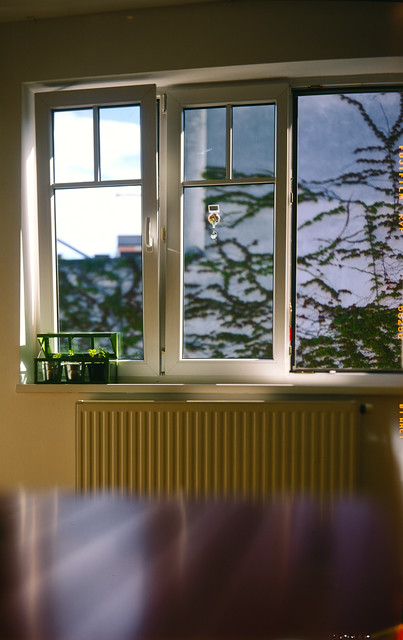
amtshaus
(Voigtländer Bessa 6x9, Ilford FP4 Plus 125, ISO 125/22°)

The idea was simple: take a film picture each and every Sunday for a whole year and (try to) post them each and every Sunday for a whole year. Of course, a couple weeks delay needed to be taken into account for development and scanning.

On Sunday January 4th, 2015, I took the last picture of my series.

ginesta (52/52)
(Super Ikonta BX, Kodak Ektachrome E100VS, ISO 100/21°)

It was a very interesting experience. Some weeks I discovered myself thinking about which camera and film I would use already on Thursday, other weeks I needed to improvise a bit more. I took the opportunity of the Sunday pictures to do a little experimenting. Some of them came out fine, especially with sheet film and home development.

caseta nova (32/52)
(Kodak Recomar 33, Fujichrome Velvia 50, ISO 50/18°)

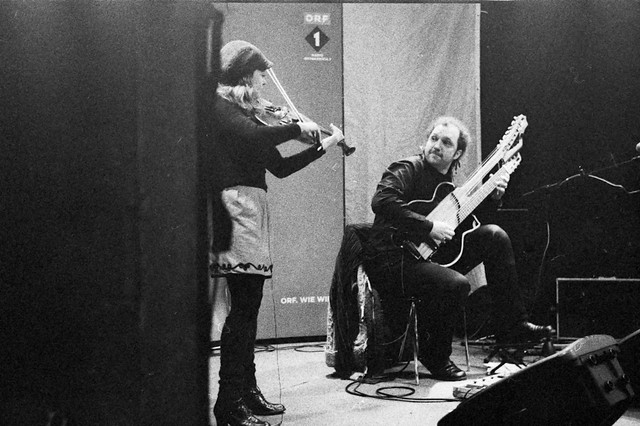
synchronicity (47/52)
(Zeiss Ikon Contax IIa, Fuji Neopan 1600, EI 3200/36°)

In other fronts it was a complete fiasco, like with Minox subminiature film: 2 out of 2 attempts came out blank! :(

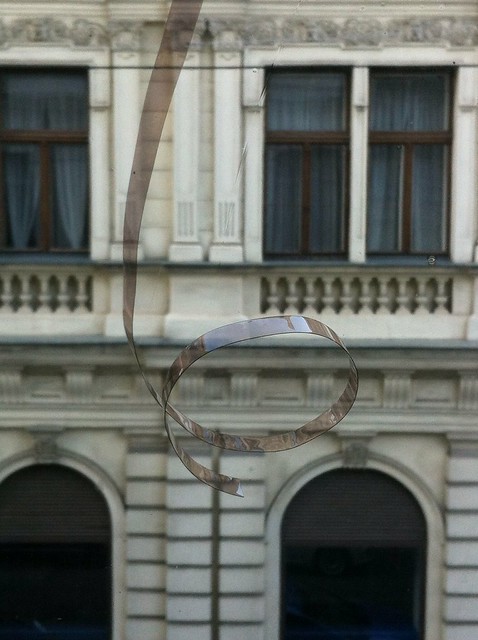
epic fail :( (22/52)

I used 21 cameras, most used on medium format film was my Voigtländer Bessa 6x9 (6 Sundays) and on 35mm film both my Kiev 4 and my Contax IIa (4 Sundays each).

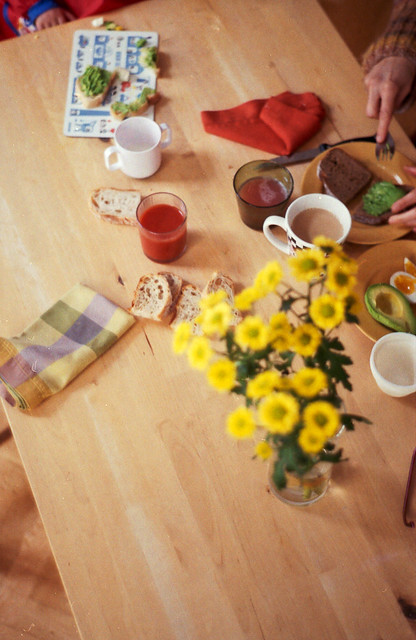
It is difficult to pick up a favorite from the 52 Sundays. But, if I had to, I would say 07/52 (Sunday, February 23rd, 2014) is it.

high angle breakfast (07/52)
(Kiev 4, Porst Color-X 200, ISO 200/24°)

To me, it conveys the feeling of an early breakfast on a winter Sunday before taking out our whole winter equipment and go for a hike in the woods.

Thanks for coming along with me all this year. I hope you enjoyed it at least as much as I did :)

Tuesday, December 16, 2014

Happy 4th Analogversary! (3/3)

(...continuing from here and here)

Without a doubt, this year's highlight has been the completion of my dearest camera project.

Two years ago, as I was celebrating my second analogversary, I told you about what was to be my most special challenge for the following year: the quest for a camera made in 1912, exactly 100 years before our son was born. Romantic as I am, I wanted to find one that was still able to take photographs.

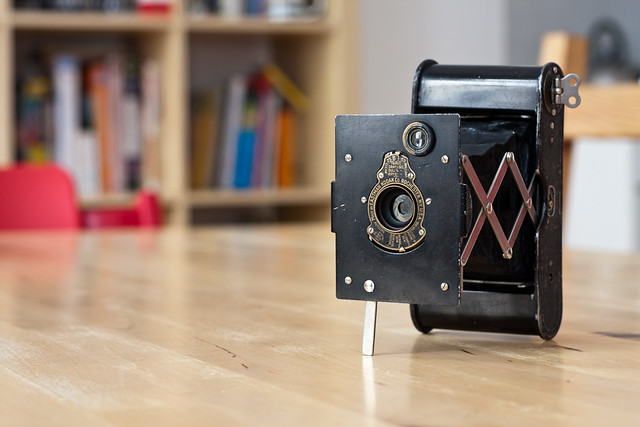
One year ago, on my third analogversary, I told you about one Vest Pocket Kodak that I found here in Vienna. This camera was a good candidate, since the first production run of the original (non-autographic) model took place from 1912 to 1914. It was in surprisingly good shape, especially for a near 100-year-old camera that has seen two world wars. The camera body, though, was badly deformed and the shutter did not fire at all. I did not really see a way to make it fit for taking pictures. For a couple of months I left the VPK project in standby.
vest pocket kodak

Later this year I found another original Vest Pocket Kodak which turned out to be in much poorer condition, but had a working shutter and an intact camera body. The VPK project was alive again. After some hesitation I contacted Dr. White in the UK, whose website Collecting Vest Pocket Kodak Cameras is one of the best references that I could find about this camera model. I asked him for help in dating both of my VPK cameras. He was kind enough to recognize how meaningful this quest was to me, as he seems to share with me a passion for such endeavors, and promptly helped me with his ample knowledge. After some exciting e-mails he was able to confirm to me that, without a doubt, the first camera that I had, the one with the deformed body, came from the first production run in 1912. Square bellows, no "choke" to limit the maximum aperture and, crucially, no lettering on the front standard and no horizontal bar to help switch the waist level finder from the portrait to the landscape position were the features that pointed it to 1912. Again my deep gratitude to Dr. White for his help and for being such a key part in my 1912 camera quest.

I was very excited by this finding but still was not able to use the camera. I decided to build myself a working camera keeping as many parts of the 1912 one as I could. I exchanged the deformed camera body (in fact it is just the back: everything else, bellows, struts, front standard, shutter and lens completely detach in a block from the camera body) with the healthy one. Then I planned to mount the working shutter and lens onto the 1912 front standard but, in a touch of inspiration (with much trial and error and the minute bending of one crucially actuating lever), I managed to fix the 1912 shutter and to make its leaves open and close again. Which is fortunate, because both 1912 lens and shutter are in an almost pristine condition, contrary to the other one, which clearly shows its age. To sum up, I have now a working 1912 Vest Pocket Kodak with a back that, at the latest, was made in 1913 or 1914. This is not only the oldest but without a doubt the most special and meaningful camera that I own.
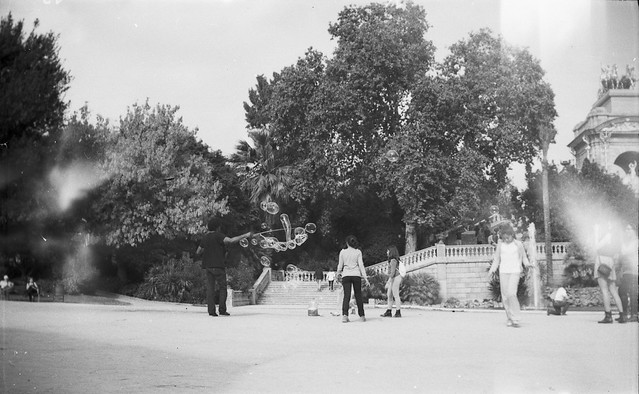
bubbles (43/52)
(Vest Pocket Kodak, Meniscus Achromat, Efke 100, ISO 100/21°)

It made me especially happy that the first pictures that I took with this camera were those of our son's second birthday, 102 years after the camera was built. After developing the film and looking at the pictures I was truly impressed by the performance of this very simple meniscus lens. The light leaks apparent in both pictures I am posting here are not the camera's fault, but mine: as I took out the exposed roll of film from the camera, the protective paper unrolled a bit and let a little light in. The camera bellows is perfectly light tight.
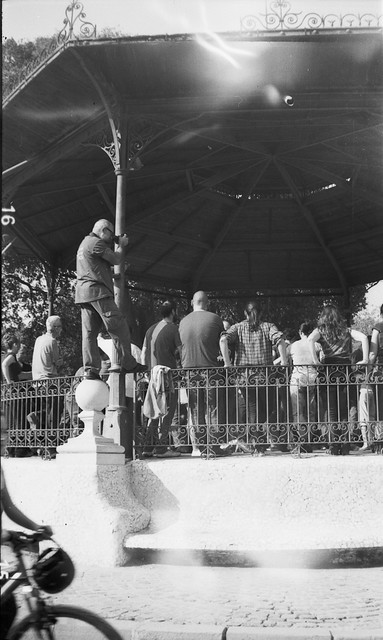
the photographer
(Vest Pocket Kodak, Meniscus Achromat, Efke 100, ISO 100/21°)

The 1912 Vest Pocket Kodak is not the most convenient camera to use, but still quite usable and, as its name promises, extremely easy to carry around. I used it again two weeks ago on 2nd Winter 127 Day (127 film was, in fact, introduced in 1912 specifically for this camera model!) and I am taking the 1912 VPK with me again this Christmas.

~ ~ ~ o ~ ~ ~

My plans for the next year are again collect less and shoot more. Well, not only shoot more but shoot better. I want to concentrate on using less cameras, my dearest ones, and try to take the most out of them. In this year I have the feeling I experimented too much: too long expired films, too extreme lighting conditions, too many poorly thought pictures shot hoping that they would come out fine. Most of them didn't. I wish to be able to take a little more time and consciousness in the picture taking act. I know I already have fine cameras and lenses, very capable of delivering quality. The weak link in the chain is now the photographer. I also want to concentrate on less films, the ones that worked best, and try to make the film choice a conscious picture taking decision at the same level as are framing, composition and depth of field.

I want to keep on doing my own repairs. Working on my cameras not only makes me strangely happy but also makes me know them a lot better. I (begin to) deeply understand what happens as I cock the shutter, as I advance film, as I change shutter speeds, inside many of my cameras. And this knowledge is gold for the times when things do not work properly. I really wish I manage to make the shutter in my Contax II work, since I have the gut feeling this camera could be the one to which I will always be returning.

I want to extend my developing skills beyond black and white. I am going to research the feasibility of developing color negative (C-41 process) and/or color slide (E-6 process) film at home, because I keep reading that it is not harder than black and white development. And, yes, I still find this caffenol development thing very exciting... :)

And, of course, I want to find more time to write about my photographic challenges here in my blog. I hope you'll keep on sharing this journey with me! :)

Friday, November 21, 2014

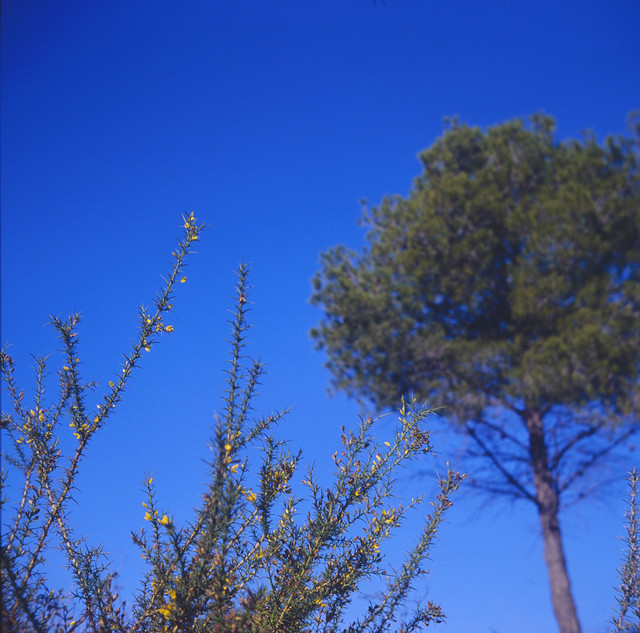
good luck [stranger 22/99]

good luck [stranger 22/99]
(Kiev 4, Jupiter-12, Kodak Elite Chrome Extra Color 100, ISO 100/21°)

My twenty-second stranger, fully equipped, was really committed to the business of bringing us good luck.

Wednesday, July 9, 2014

sofortdienst [stranger 21/99]

sofortdienst [stranger 21/99]
(Rollfilm 5x8, Rollei Crossbird 200, ISO 200/24°, cross-processing)

My twenty-first stranger was talking on the phone.

Sunday, February 9, 2014

A year of film Sundays 2014

Although I didn't directly participate on it, I have a number of flickr friends in the group Camar[•ⓐº]das. One of the (many!) challenges that they are doing is to take a picture each and every Sunday through a whole year: A Year of Sundays.

This year, Mar and I decided that we are going to try the challenge, but we are going to do it on film: A Year of Film Sundays. 52 pictures taken on film every Sunday. Today I posted the second one already.

amtshaus
(Voigtländer Bessa 6x9, Ilford FP4 Plus 125, ISO 125/22°)

wienerberg
(Kodak Recomar 33, Kodak Ektachrome 200 EPD, ISO 200/24°)

I think it will be really a challenge, especially for not repeating too many topics and trying not to be too boring. On the other side, I plan to use it as a chance to do more experiments, like shooting on sheet film (like 02/52).


The whole set can be seen (growing!) here. Stay tuned! :)

Tuesday, January 28, 2014

My first home b&w development!

Last Sunday I developed my first black&white film at home. And I must say that it was not as complicated and messy as I thought it would be. I develooped a medium format roll of Ilford FP4 Plus 125 that I shot with my Voigtländer Bessa 6x9 (with a 6x4.5 mask in place).

First I loaded the exposed film into the reel. This step needs to be done in complete darkness, so I used a changing bag. It was surprisingly quick, I was a little concerned it would be difficult, I read some "horror stories" about loading a medium format film into an AP reel, but it was not at all that hard. Then the reel went into the developing tank and the rest happened again in the light.

motorrad
(Bessa 6x9, Ilford FP4 Plus 125, ISO 125/22°)

Since the developer that I got is one of the modern formulations of Rodinal (having been patented in 1891 by Agfa, Rodinal is, in fact, the oldest photographic product in the world), I chose stand development, which basically consists of letting the developer slowly do its job without (almost) any interference for a long period of time. In my case, I inverted the tank for a minute each 2 seconds at the beginning (it should have been only 30 seconds), and for fifteen seconds after one hour. In total I let two hours pass before I applied stop bath and fixer.

double exposure
(Bessa 6x9, Ilford FP4 Plus 125, ISO 125/22°)

I am quite happy with the results. Well, the roll was not at all so well exposed (some overexposures, many out of focus shots, some accidental double exposures), but the development results are very promising, and I found the whole process quite easy and pretty much manageable for a lazy Sunday afternoon.

bin
(Bessa 6x9, Ilford FP4 Plus 125, ISO 125/22°)


Stay tuned, there will be more home development in the next months! :)

Wednesday, December 11, 2013

Happy 3rd Analogversary!


Three years ago, on December 11th 2010, I posted my first film picture on flickr. Three years later I continue taking pictures almost exclusively on film and I still enjoy using old cameras for it. Although this third analogic year has seen a strong decline in the number of films that I put through my cameras and to the number of posts in this blog as well, there has been no decline in my commitment. I guess the reduced action has probably more to do with rising our one-year-old son, an enterprise which unfortunately (or maybe gratefully so) does not leave one with many opportunities to take pictures, especially with certain cameras.

I am happy this year because I kept on doing my own camera repair and servicing and, although not always with a happy ending (the film advance in a Contina Ia is still waiting for my fourth attempt), I've managed loosing the fear and feeling almost comfortable around dismantled shutters and the smell of lighter fluid.

In this third analogic year I shot 32 rolls of film (13 black&white, 12 color negative and 7 color slide) using 16 different cameras. The camera that I used most often has been a new acquisition: I shot 6 rolls with an Exakta Varex IIa that I got looking for the origin of those uncountable many SLRs with interchangeable optics that we have today (and that already existed yesterday). The discovery of the Exakta has been probably one of the three highlights in camera collecting this year. I do not see myself as a camera collector but as a camera user, because I really use all my cameras, and acquire them solely with the purpose of using them. Nevertheless, I guess to compensate inconsciously for not being able to photograph as much as I wanted to, this year I ended up acquiring a little more cameras and especially accessories than I used to in the past. Living now in Vienna and having a much easier access to many sources of cameras and gear has for sure been another factor. As I said, my Exakta outfit with four lenses and two viewfinders is proof of that.

exakta family

The second highlight has been undoubtedly the resurgence of Voigtländer. I have always been a deep admirer of the fine cameras and lenses coming from Brunnswick. In fact, the Heliar f/4.5 lens on my Rollfilm 5x8 was my self-given gift for my first analogversary. Ever since then, I dreamed about owning the second variant, Heliar f/3.5, but unfortunately the price tag on them were just too much for me and my moral. This fall I had the chance to acquire this lens, attached to a most wonderful Bergheil 6.5x9 plate camera, for a very reasonable price. And then I remembered just how much of a jewel these cameras are and why do I love them so much. Later on I was able to secure a Vitomatic IIa 35mm rangefinder camera (I already owned a non-rangefinder Vitomatic Ia and gave it away) and a Bessa 6x9 rollfilm camera (which I always wanted) both for ridiculously low prices, ending up with a nice happily growing Voigtländer family.

voigtländer family

The third highlight, though, is the one that makes me the most happy. Last year I already wrote about my quest for a camera made in 1912, a camera that would be 100 years older than our son. There have been a number of candidates and near-hits this year: a Vest Pocket Kodak that ended up being autographic and thus some years younger, an Icarette 6x6 from 1918, a much battered and ugly Ansco Vest Pocket No. 1 which could be it but I suspect it to be from a little later, ... Last month I got a non-autographic Vest Pocket Kodak, the camera that many American soldiers (ilegally) had in the trenches during World War I. The production run of the non-autographic VPK is quite short, 1912-1914.

vest pocket kodak, 1912-1914

My camera has a fairly low serial number, around 30000, although serial numbers seem not to be a very reliable dating feature for Kodak cameras. I guess I'll never be completely sure if this camera was indeed built in 1912, but I like to think that chances are good. I will try to make this camera fit to take pictures again. It won't be easy, since the body seems to be bent sideways and the camera does not close properly. The shutter is almost working (still have to figure out how can an actuating lever be a fraction of a millimeter shorter than it should) and the receded meniscus lens looks fine.

For my next analogic year I will try to photograph a little more and collect a little less. We recently got a scanner that can properly handle film up to medium format. Until now I have been digitizing my pictures basically by taking a backlit digital picture of the negative. Not comfortable and definitely not fun, especially when it comes to inverting colors by hand in the computer. This year I let my lab scan many films and many others are still patiently waiting to be digitized. There's going to be some learning about scanning film properly this next year. But the photographic challenge I am most excited about is to do my own film development. For my birthday Mar got me a film development starter kit, with a daylight tank, a thermometer, bottles and everything I need. I plan to start with black&white but I still need to do a little research about chemicals and options. And, yes, there is also this very exciting caffenol development thing... :)

I hope that you keep sharing this photographic journey with me! :)

Wednesday, October 2, 2013

Darkroom workshop

Recently I attended a classic black&white darkroom technique workshop, where I learned all steps that must take place between taking the exposed film out of the camera and holding your picture in your hands on photo paper. On the first day we went out, exposed a roll of film and loaded it in the darkness into a developing spiral that went into a developing tank.

On the next day, the developed rolls were already waiting for us. We produced a contact print of all pictures taken and selected one to be enlarged. In this process we learned all about adjusting brightness and gradation and produced many copies of the selected picture, just to see how different the results can be by changing time of exposure or by using coloured filters.

This was my picture, taken with a Rolleiflex Old Standard 621 on medium format film.

dunkelkammer
(Rolleiflex Old Standard 621, Rollei Retro 400S, printed on Ilford Multigrade paper)

And this is another version, with much stronger gradation, that our teacher produced just as an experiment, as she rightly tought it would fit better with the mood of my picture.

dunkelkammer 1
(Rolleiflex Old Standard 621, Rollei Retro 400S, printed on Ilford Multigrade paper)

From the whole experience the step that astounded me the most, every single time I did it, was to immerse the exposed photo paper into the developing bath and see the picture emerge in the reddish dim light of the darkroom. The picture, that was first just an idea, then a temporary image on the viewfinder, finally appearing before the photographer's eyes, after having been latent on film and then revealed first as a negative image, exposed again with the enlarger and then being latent again, this time on photographic paper.

Manny thanks to Natascha Auenhammer from Zebra Labor for spreading her know-how and guide us through the reddish darkness of darkroom work.


Wednesday, December 12, 2012

Happy 2nd Analogversary! :)

Two years ago, on December 10th 2010, I posted my first film picture on flickr. One year ago, I already celebrated my first "analogversary". Today, one year later, here I am, still going strong on my commitment to film photography with vintage cameras.

This second year has been one of more mature camera choice and use, in general a year of more thought of photography. All in all, I exposed 71 films (22 black and white, 32 color negative, 17 color slide) using 14 different cameras. The camera that I most often used was my Rolleiflex Old Standard 621 (18 rolls). The color negative film that I most used was again Kodak Portra 400 (8 rolls), for black & white Kodak Tri-X 400 (3 rolls) and on color slide Fujichrome Velvia 50 remained a favorite (5 rolls).

In this year I got 5 new (old) cameras (Rolleiflex, Contessa, Ikonta, Super Ikonta BX and Rollei 35). In order to balance the energy, I also gave 5 cameras away (Polaroid, Vitomatic, Flexaret, Beltica, Hapo). As it seems, I am taking a more mature stand to vintage camera use, since I only got cameras that have some kind of significance, some meaning.

Another reason I am happy with my second analogue year is that I managed to accomplish one of the challenges that I set myself last year: doing my own camera repairs, which is a natural step when the objects you are trying to work with are (almost) all many years older than your parents. I got tons of patience, some specialized tools, and lots of information and good advice from websites and flickr pals. I managed to recover all speeds of the Compur shutter on my Rollfilm 5x8, to repair the jammed film transport in my Contessa 533/24 and to lubricate the focus system and recalibrate the rangefinder on my Super Ikonta BX 533/16. Oh yes, and there were some fun experiments with junk Compur shutters, too... :)

I will definitely keep photographing on film with vintage cameras next year. My next project, though, has all the meaning of the world for me: 6 weeks ago Mar gave birth to our first born. Long before I could hold him in my arms, I thought I would try to find a camera from 1912, a camera 100 years older than our child.

happy 2nd analogversary! :)

This camera, a Vest Pocket Kodak, could have been the one, since it was introduced in 1912, like the 127 film that it takes (and it fact, 127 film was especially designed for this camera). Some of its features (lens, body finish, autographic feature, engraved patents), though, point it to a little later (1921-1926).

The quest, thus, is still open. I'll be happy if you keep sharing this journey with me! :)

Saturday, December 8, 2012

(2nd) Winter 127 Day 2012

Yesterday, December 7th, was the 2nd Winter 127 Day (12/7, as written in American fashion). Although the "official" date seems to be January 27th, I decided to load a Rollei Nightbird 800 into my Voigtländer Rollfilm 5x8 and take a couple pictures on 127 film.

foto
(iPhone 4, Hipstamatic, Jimmy lens, Ina's 1982 film, no flash)

I am not expecting great pictures, because there were too many exposure mistakes (I forgot to set the aperture at least twice!), but maybe some kind of fate muse smiled at me anyway. The exposed film is already prepared to be sent to the lab next Monday.

Sunday, September 2, 2012

renfe te da la bienvenida [stranger 20/99]

renfe te da la bienvenida [stranger 20/99]
(Vito I, Kentmere 400, ISO 400/27°)

My twentieth stranger checked her smartphone once again as the train was leaving the station.

Sunday, August 19, 2012

Herrensalon Wistuba

I am not a superstitious person. I like black cats no less than any other cat, I have no problem walking under a ladder and I do not seem to show any feeling whatsoever about Friday the 13th. What I do have, though, are certain funny little ways, certain everyday "rituals", that I unconsciously link to the success or failure of my daily enterprises. Crossing a certain street at a very concrete point on my way to work, leaving the fork to rest on the plate pointing down at the end of my meal, or hanging my bag to my right in the morning and to my left in the afternoon are a few examples of such rituals.

As taking photographs is an important part of my life, these kind of obsessions have spread throughout my photography as well. In fact, it seems to be not uncommon. I read that photographer Henri Cartier-Bresson had the superstition to test new camera lenses by taking photographs of ducks in urban parks. He never published them, as he considered it a "baptism" of the lens.

Since I am not only attracted to old cameras but also to vintage typefaces as well, the sign of a hairdresser, gone out of business a long time ago, caught my attention on my way to the office very soon. I could not resist the elegance of the bold '70s typeface, the off-center "holes" of the Rs, the well-balanced colors, the two windows, the tree, the cobblestone, ...

herrensalon wistuba
(Hapo 66-E, Rollei Retro 400S, ISO 400/27°)

That's why I started taking this picture again and again, at first almost without realizing it, later challenging myself to have a photograph of the Herrensalon Wistuba taken with every single camera and lens that I own. Talk about obsessive-compulsive disorder... ;)

herrensalon wistuba 02
(Flexaret VI, Fujichrome Velvia 50, ISO 50/18°)

herrensalon wistuba
(Nikon Coolpix S200, digital shot)

herrensalon wistuba
(Rollfilm 5x8, Kodak Farbwelt 200, expired, ISO 200/24°)

Well, sadly I have to admit that I failed the challenge, although it has been not entirely my fault. After at least 8 years of no activity, someone came to the idea of using the old hairdresser salon for a spice shop. Of course, a sign reading "Herrensalon Werner Wistuba", no matter how elegant the typeface, could be a little confusing for customers willing to buy exotic spices. The sign has been recently removed, putting a premature end to my challenge.

herrensalon wistuba
(Super Ikonta BX 533/16, Lomography Redscale 100, ISO 100/21°)

Anyhow, I have 23 pictures taken with 17 different cameras and lenses. The ultimate goal of photography is to keep memories. I'll be able to further admire the sign every time I want, in 23 different fashions.

My "Herrensalon Wistuba" set on flickr

Friday, July 27, 2012

Roll in a day / A day in a roll - 12th July 2012, All Kodak Day

On July 12th flickr group Roll in a day / A day in a roll celebrated George Eastman's 158th anniversary by shooting a roll of Kodak film and/or using a Kodak camera.

The 12th was in the middle of our vacation in Croatia, and I shot a roll of expired Kodak Portra 160VC with a Rolleiflex Old Standard 621 in and around Pula, Fažana and the Brijuni Islands. The complete set can be seen here.

My favorites are:

seagull (11/12)
(Rolleiflex Old Standard 621, Kodak Portra 160VC (expired), ISO 160/23°)


ožujsko (08/12)
(Rolleiflex Old Standard 621, Kodak Portra 160VC (expired), ISO 160/23°)


Tuesday, July 17, 2012

Roll in a day / A day in a roll - 22nd June 2012, All B&W day

The fourth round of Roll in a day / A day in a roll happened a little while ago, on June 22nd.

This time the group called for a black&white day. I decided beforehand to use the Flexaret VI for this round, but unfortunately, I had no b&w medium format film available. I used a roll of Fujichrome Velvia 50 and converted the color shots to black&white using pretty much the standard conversion in Lightroom.

This round was interesting in that it was not on a Saturday but on a Friday, so I needed to combine the shooting with my work. Interesting indeed.

My favorite shots are the following:

bus (10/12)
(Flexaret VI, Fujichrome Velvia 50, ISO 50/18°, b&w conversion)


kaslöchl (11/12)
(Flexaret VI, Fujichrome Velvia 50, ISO 50/18°, b&w conversion)


karte à €0,40 (12/12)
(Flexaret VI, Fujichrome Velvia 50, ISO 50/18°, b&w conversion)

Wednesday, May 16, 2012

Thursday, May 3, 2012

The film - Roll in a day / A day in a roll - April 21st 2012

The Tri-X 400 film that I shot on April 21st came back from the lab yesterday.

contact sheet_petit

You can see the whole roll on my flickr set here. I started my roll of film at 9am having breakfast in Augsburg and finished it at home in Salzburg at 5pm. My favorite shots are these:

mild hangover breakfast (02/36)
(Ikonta 522/24, Kodak Tri-X 400, ISO 400/27°)

foreground brake (07/36)
(Ikonta 522/24, Kodak Tri-X 400, ISO 400/27°)

US Tram (22/36)
(Ikonta 522/24, Kodak Tri-X 400, ISO 400/27°)

spring leaves (25/36)
(Ikonta 522/24, Kodak Tri-X 400, ISO 400/27°)

we scream for ice cream (30/36)
(Ikonta 522/24, Kodak Tri-X 400, ISO 400/27°)

It was again a lot of fun, and not at all difficult to shoot the whole 36 exposure roll. I'm also impressed with the performance of the Novar lens. As I said, I wanted to sacrifice this camera to donate the film transport to my dormant Contessa 533/24. As it turned out, I managed to fix the film transport in the Contessa without needing anything from the Ikonta, so it seems I got myself yet another little 35mm viewfinder camera... :)

Saturday, April 21, 2012

Roll in a day / A day in a roll - April 21st 2012

Roll in a Day / A Day in a Roll - 2nd round, 21st April 2012
(Canon PowerShot A560, 1/20, f/2.6, ISO 80)

The second round of Roll in a day / A day in a roll has been today, April 21st 2012. This time I used a whole 36 exposure 135 roll of film, a black&white Kodak Tri-X 400, one of my favorites.
The camera has been a Zeiss Ikon Ikonta 522/24 that I just got last Thursday and that I plan to eventually use to donate the film transport mechanism to a Contessa 533/24 that is in need for a new one.
I wanted to run a roll of film through the Ikonta first, though, to see how the Novar lens performs. It is a lovely, handy and very fine camera to use. My roll has been shot between Augsburg, Munich and Salzburg. Let's see how it turns out... :)

Saturday, March 31, 2012

Results: Roll in a day / A day in a roll - March 24th 2012

The film that I shot last Saturday came back from the lab yesterday.

contact sheet

You can see the whole roll on my flickr set here. My favorite shots are these two:

double selfie (02/12)
(Rolleiflex Old Standard 621, Kodak Portra 400, ISO 400/27º)

heaven (12/12)
(Rolleiflex Old Standard 621, Kodak Portra 400, ISO 400/27º)


I really enjoyed doing this, it was fun. Next time I guess I'll be using a 24 or 36 exposure roll, since 12 was much too few! :)

Thursday, March 29, 2012

db [stranger 18/99]

db [stranger 18/99]
(Flexaret VI, Rollei Digibase CN 200, ISO 200/24°)

My eighteenth stranger was reading the newspaper on his way to Munich.

Saturday, March 24, 2012

Roll in a day / A day in a roll - March 24th 2012


Roll in a day 20120324
(EOS 40D, Canon EF 24mm f/2.8, 1s, f/5.6, ISO 400)

Yesterday I learned of Roll in a day / A day in a roll, a recently created spin-off of flickr group I Shoot Film, where a bunch of film photography enthusiasts are going to shoot a full roll of film in one day, and publish all pictures afterwards (the good ones and the duds).

Today, March 24th 2012, is the first day. I'm going to participate with my Rolleiflex Old Standard and a roll of Kodak Portra 400. Any film people who care to join are very welcome.

Let the fun begin! :)