Showing posts with label stories. Show all posts

Tuesday, October 25, 2016

Adventures on Rolleiflex repair

On March 2015 I got a Rolleiflex, an early Automat (2nd Model, K4B build 631), built around 1938.

Compared to its predecessor (the Rolleiflex Old Standard), the Automat introduced a number of crucial improvements that enabled photographers a much faster workflow. After loading film and closing the camera, one just needs to slowly wind the film and the camera stops automatically at the first frame (no need to check first frame alignment with a red window as in the Old Standard, and pretty much every other camera at the time). Shared with the Old Standard is the film transport through a crank lever with an automatic stop for the next frame; new was that this same crank lever turn tensions the shutter as well. Double and blank exposure prevention were too introduced.
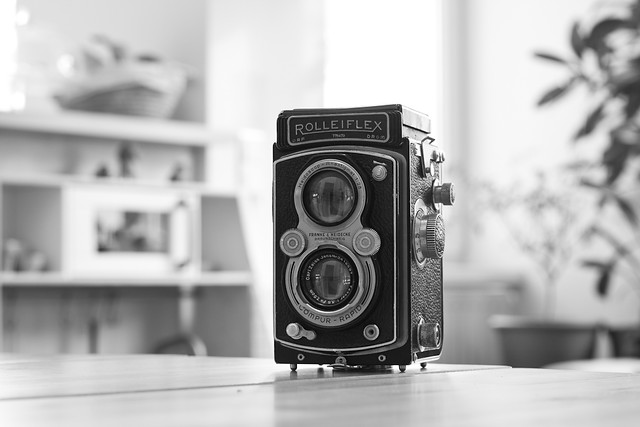
rolleiflex automat 631

When I tested my Rolleiflex with film I noticed many problems. Although the film counter started running correctly after 5 or 6 turns of the crank, the film advance did not stop at the first frame. If the lever was in the "ready" position (at an angle around 1 o'clock), the shutter could be released and a picture could be taken. The usual crank movement for Rolleiflex film transport (turn the crank clockwise until it stops to advance to the next frame, turn it counter clockwise again to return it to the "ready" position) did not stop at all: you could turn the crank freely until after the whole film was wound on the take up spool! The counter clockwise turn did not stop at the one o'clock position either.

There were some issues with focusing as well. The front standard traveled smoothly across the close focusing range, but there was a definitely noticeable resistance to reach the infinity position, where the standard is closest to the camera body. The taking lens, in fact, was not able to focus at infinity at all.

Oh, and yes, the slow speeds of the Compur Rapid shutter were dead, too, but this is something that I already knew from many of the prewar cameras that I have.

Soon I got the nerve to open the camera to take a look at what was going on inside.

FIRST EXAMINATION: FILM ADVANCE (March 2015)

Symptom: free turning of the film advance crank lever. It should lock on the ready-to-shoot position. After taking a picture, a clockwise turn should stop after advancing exactly one frame, and then a counter clockwise turn should stop again at the ready-to-shoot position.
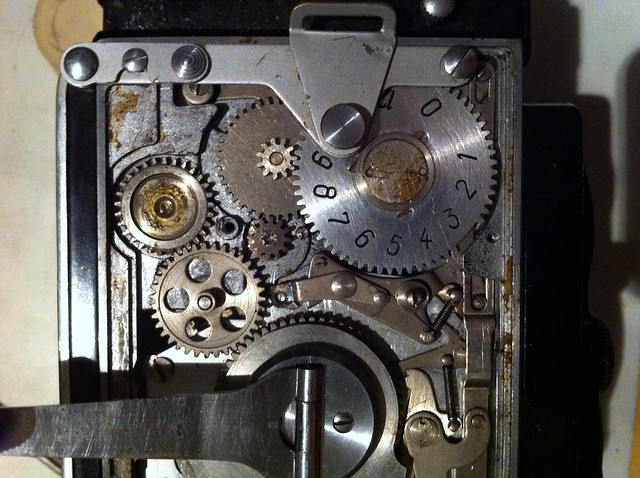
Rolleiflex Automat 631 - film transport

Diagnostic: missing dowel actuating as cam follower. There is a large cam that turns with the crank lever. A lever with a hole on its tip was bent down and made friction against the base plate, which prevented its free movement. If this lever was held in a definite position, the film advance blocking mechanism was activated and the clockwise turn of the crank lever was correctly blocked after advancing exactly one frame. I assumed that the hole was supposed to contain something, a little rod, a dowel, that held the lever exactly on this position as the crank lever started its film advance. The counter clockwise turn of the crank lever should be blocked by this same missing dowel making contact with an obvious metal stop on the cam.

Very probably, someone forced the crank lever backwards too violently past this stop, separating the dowel from the lever and bending the lever down. I was able to reproduce the proper film advance stops by holding a screwdriver in place of the missing cam follower.

As a temporary solution to be able to use the camera, I blocked the free movement of the lever with a toothpick tip to allow free turning with no stops. I could "simulate" the film advance manually by aligning the next frame number in the film counter, as if it was a red window.

At this point, I tried to imagine ways to build myself a replacement for the missing cam follower.

FIRST REFLECTION BREAK

How did it happen? My flickr friend Hans Kerensky pointed me to a couple of pictures from Gustavo Vasquez, who seemed to have faced a similar problem. In his case, the dowel got caught in the gears of the film transport, blocked everything and did a lot of damage. By forcing a locked crank lever backwards, one could break or at least dislodge the dowel. This seems to be a design weakness in early Automats that was addressed in later versions.

If in Gustavo's Automat the dowel was found inside the camera, I started wondering if the dowel in mine could have stayed inside as well. One day, then, it struck down on me. Was it possible that both issues (film advance and focus at infinity) were linked? Was it possible that it was precisely the missing dowel what was preventing the front standard to reach infinity focus position?

SECOND EXAMINATION: FRONT STANDARD (May 2015)

A boring train ride back to Vienna, the Automat and a screwdriver.

I removed the front fascia by carefully removing the leatherette on the front to reveal four screws. As I was expecting, the front standard, without the fascia, reached infinity focus precisely and smoothly. The problem, thus, had to be somewhere in the front fascia!

On closer inspection I found something, what seemed to be a tiny metal piece, caught in the lower crate, obstructing the last half millimeter of travel needed to reach infinity focus. I got my tweezers, my hands almost trembling with excitement, and took it out of the place where it had rested for at least the last 40 years. It was the missing dowel, yes.
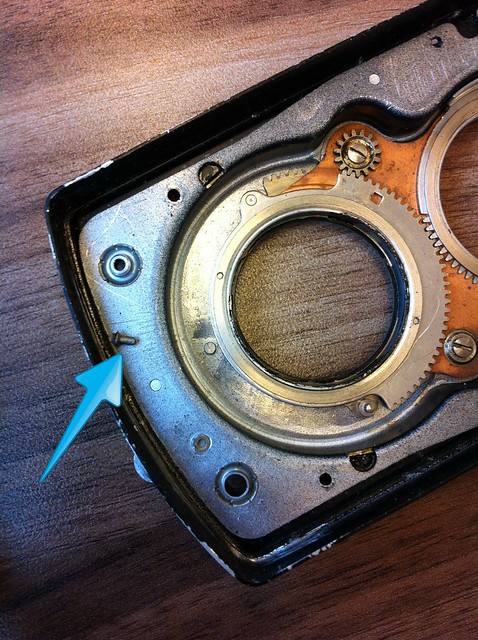
Rolleiflex Automat 631 - missing dowel

SECOND REFLECTION BREAK

Well, now I was quite happy because I got everything that I needed to fix the camera. But how to reattach the dowel?

The thing is really tiny (less than 1 mm in diameter, around 3 mm long) and the violence of the blow had left its traces in both the dowel and the hole where it was supposed to be attached. After some failed attempts at just pressing the dowel into the hole, I gave up. It wouldn't go.

I packed everything carefully and reattached the toothpick tip to block the lever, so that the camera could be used without automatic stops. Using the frame counter as a "red window" I could manually advance the film to the next frame. It was of course not as comfortable as the true Automat function, but at least I could use the camera.

In fact, I shot 13 rolls of film with the Automat in this way. And, as it was with the Old Standard, the pictures that this camera was able to produce surpassed my expectations by large every time. If I have learned something about Rollei TLRs is that they never ever disappoint.

THIRD EXAMINATION: GO FOR IT! (October 2016)

For one reason or another, I was scared of this repair. In fact, it took me almost one year and a half to gather the courage to open up again the right side of the Automat.

Last week, finally, I got the courage to delve into its guts and, once again, marveled at its ingenious yet simple mechanics. I guessed that the violence of the shearing had deformed the hole a little bit, elongating it to an ellipse. I got a very tiny file and tried to file a little into the hole to make it broad enough to replace the dowel. I filed the edges of the dowel, too, so that it could more easily be reattached into to its hole.

A little filing, then one attempt. It wouldn't go. More filing, second attempt. It still wouldn't go. I realized that I would need to apply the pressure to reattach the dowel with a tool. I got pointed pliers and tried to get the dowel just enough into the hole so that it would not fall. Then I applied uniform pressure to the tip of the dowel and to the lever with the pliers and I realized that the dowel was in fact very slowly going into the hole. At the end I applied a few tiny drops of instant glue to not let it fall again.
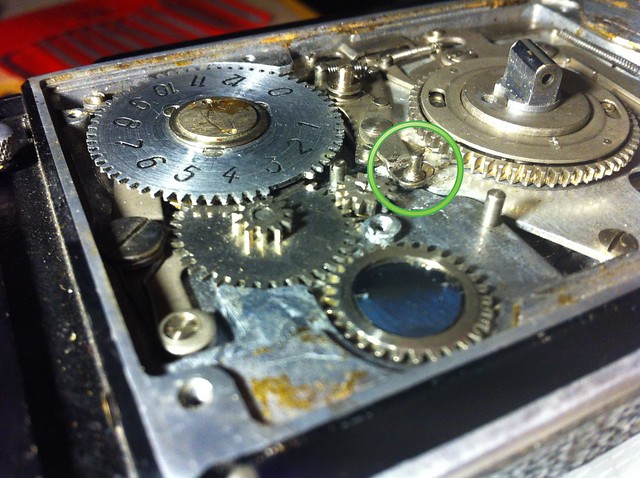
Rolleiflex Automat 631 - Dowel in place

The dowel was again where it was supposed to be. I loaded my "Automat test film" into the camera. This is just the protective paper of a 120 film with a short length of film carefully taped into it where the film start is supposed to be, so that the automatic film start feeler could be "cheated". I closed the camera and slowly turned the crank lever clockwise. The dowel ran smoothly below the cam, through a "passage" at the right place to hold the crank lever free. Then a little resistance needed to be overcome and I heard the distinctive click as the frame counter was engaged. Sure enough, the frame counter wheel started turning slowly, and the lever with the dowel changed its angle minutely. As the frame number 1 reached its proper position on the film gate, the powerful film advance lock mechanism stopped the crank lever clockwise turn. The crank lever could now be turned counter clockwise. The dowel ran above the cam until it blocked its movement as it made contact with the metal stop on the cam (if done very brutally, this could dislodge the dowel again!). After releasing the shutter for the first frame, the film could be advanced again until frame 2 and then the crank lever turned counter clockwise to the ready position at one o'clock. This way, I was able to reproduce the proper Automat film advance.

My Automat, as it seems, is now ready to be used as it was meant. I am eager to shoot a roll of film with it.

PS: The previous owner of my Rolleiflex, who was as well the one that bought it new in 1938 or early 1939, was a merchant from Gmunden in Upper Austria. He was born in 1904 and died in 1981. As his grandson told me, he was a passionate mountain climber, especially on the Dolomites, and he used this same camera to take many pictures of his endeavors.

Rolleiflex Automat 631
My Rolleiflex Automat 631 flickr set

Maker Franke & Heidecke
Model Rolleiflex Automat K4B build 631
Type twin-lens reflex camera
Viewing Lens Heidoscop Anastigmat 75mm f/2.8
Taking Lens Carl Zeiss Jena Tessar 75mm f/3.5 (No. 2416597, 1938)
Shutter Compur Rapid, 1 - 1/500 + B + T
Film type 120 6x6
Year January 1938 - March 1939
Country Germany

Monday, March 23, 2015

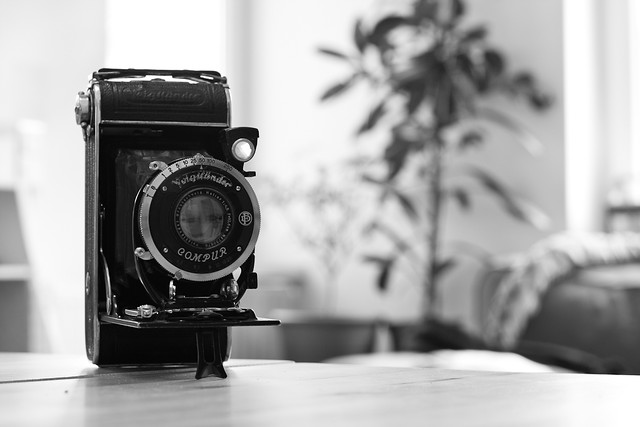
Two cameras for a lens - Voigtländer Inos I

Last November I got a Voigtländer Inos I at a fairly low price. I decided to get it mainly because of the lens, an early Voigtländer Heliar f/4.5. I already have such a lens on my Voigtländer Rollfilm 5x8 and I am deeply in love with the very unique pictures that it produces. Unfortunately, the relatively exotic 127 film format that the Rollfilm 5x8 requires is not very convenient: film choice is very limited and the prices are on the high side. For this reason, I thought a 6x9 folder using 120 film (readily available in a decent variety of films at reasonable prices) with a Heliar lens was a good idea.

I was not able to check the camera in person before I got it. I could just look at a single low-quality picture, enough to see that the lens was in fact a Heliar but not much more. As the camera arrived and I opened up the package, the camera turned up to be in quite poor condition: leather was missing from the front and sides, rust had found its way onto many spots, sports and wire frame finder were not there and it felt like it had not been taken care of in the last sixty years. The lens, though, looked pretty clear, which was the whole point of it. I improvised a crude "leather" covering and got the thing running again.

crude camera covering job... #diy #electricaltape #vintagecameras #voigtländer

A photo posted by tonicito (@tonicito75) on


The shutter though, showed quite a strange behaviour: slow speeds were a little too slow, which is common because of hardening lubricants in the mechanism, but time and bulb settings, in which the shutter can be opened and closed manually through the release lever, would not respond at all and 1/250, the shortest speed, sounded and looked to me more like 1/50 or 1/100. This called for a closer inspection, so I carefully opened the shutter and discovered that a number of important pieces were missing: the B-lever, which connects the shutter release to the blade operating ring for T and B operation, was nowhere to be found. This could still be OK, since these are speeds that are rarely used except for long exposures. Unfortunately the booster spring was missing, too. This is one strong coiled spring that gives the shutter the extra tension needed to achieve its highest speed, a tension which is very noticeable when cocking the shutter at 1/250. Without the highest speed, I needed to stop down the iris to compensate, and "large" apertures (we are still talking f/4.5, so were the figures in the 20s-30s) is a favourite spot for me using a Heliar.

I accepted the facts, shot a roll of film with the camera and shutter as they were, fell in love deeply (again!) with the Heliar lens, and let it sleep. In the background I searched for a similar 6x9 folder with a compatible Compur shutter to obtain the missing parts, or to exchange mine, but found nothing. Last month, though, I did find such a 6x9 camera. And, ironically, it was yet another Voigtländer Inos I, in much better condition, and again with a fairly low price tag. This one sported an Anastigmat-Skopar f/4.5 lens which, for all that matters, is an excellent performer. It is no Heliar, though.

... but that #Heliar lens is oh so wonderful! #diy #vintagecameras #voigtländer

A photo posted by tonicito (@tonicito75) on


The shutter on the second Inos has all its parts in place. The camera has even the body piece of the sports finder which, incidentally, proved that it was indeed the relatively rare Inos I for dual format (6x9 and 4.5x6) and not the much more common Rollfilm 6x9. The shutter required a little service because the slow speeds would run much much too slow. The booster spring needed attention, too, because sometimes it fell out of position when tensioning and let 1/250 run like 1/50 or so. A little pressure, lovingly applied with pliers, brought it back to a shape with which such out of position accidents seldom happened. I need to tension 1/250 with buttery fingers, though; I hope I'd manage to notice when the booster spring falls out of position when tensioning the shutter!

Both lenses having the same focal length (105 mm), the easiest way was to replace the lenses and use this nicer camera with its working shutter. I removed the Skopar lens from the "new" Inos and replaced it with the Heliar. The threads might not have been "exactly" compatible, since the front element needed a fair amount of torque to screw, but I checked infinity focus and it looked tack sharp. The first roll of film is in the making, I hope it turns out OK.

It is interesting that both my Inos I cameras are not at all very far away in time from one another. The Inos I (back then it was just called Inos) had a relatively short production run, from 1930 to 1933 (some sources say 1932), and it was quickly superseded by the Inos II. I would say both cameras were built in the same batch: their body serial numbers are just 48000 numbers apart (I guess these body serial numbers applied not only to this model but to all Voigtländer models, but I am not sure). The battered one has a higher body serial number (947270) than the nicer one (899432). Interestingly, though, both lens and shutter were a little newer (higher serial number)in the battered one. The lenses are only 747 numbers apart (760623 for the Skopar, 759876 for the Heliar). Both point to September 1933 as fabrication date. The shutter serial numbers point to 1933, too, and again the nicer Inos has a slightly newer one.

voigtländer inos i

I am happy with this camera: It is hardly possible to get a larger film format (6x9 on 120 film, that is more than six times as much area as provided by a standard 35mm camera) in a package that fits into any coat pocket so nicely as this one. The folded camera is not heavier or bulkier than the average cell phone that we used to carry around by the end of the 90s. Also, being a true Voigtländer, the quality and precision of every single component is exquisite, and its more than 70 years of various adventures are hardly noticeable when the folding bed closes nicely with a reassuring snap or the film advance key rotates as smoothly as it did in the mid thirties. And the Heliar, ah, that magical Heliar now in a much more usable package, is the whole reason why I took care of these two cameras, these almost twins that, after a long journey, reunited again.

Voigtländer Inos I
My Voigtländer Inos I flickr set

Maker Voigtländer
Model Inos I
Type folding bed camera
Lens Voigtländer Heliar 105mm f/4.5 (No. 759876, Sep 1933)
Shutter Compur, rim set, size #0, 1 - 1/250 + B + T
Film type 120 6x9, 4.5x6
Year 1933
Country Germany

Sunday, August 19, 2012

Herrensalon Wistuba

I am not a superstitious person. I like black cats no less than any other cat, I have no problem walking under a ladder and I do not seem to show any feeling whatsoever about Friday the 13th. What I do have, though, are certain funny little ways, certain everyday "rituals", that I unconsciously link to the success or failure of my daily enterprises. Crossing a certain street at a very concrete point on my way to work, leaving the fork to rest on the plate pointing down at the end of my meal, or hanging my bag to my right in the morning and to my left in the afternoon are a few examples of such rituals.

As taking photographs is an important part of my life, these kind of obsessions have spread throughout my photography as well. In fact, it seems to be not uncommon. I read that photographer Henri Cartier-Bresson had the superstition to test new camera lenses by taking photographs of ducks in urban parks. He never published them, as he considered it a "baptism" of the lens.

Since I am not only attracted to old cameras but also to vintage typefaces as well, the sign of a hairdresser, gone out of business a long time ago, caught my attention on my way to the office very soon. I could not resist the elegance of the bold '70s typeface, the off-center "holes" of the Rs, the well-balanced colors, the two windows, the tree, the cobblestone, ...

herrensalon wistuba
(Hapo 66-E, Rollei Retro 400S, ISO 400/27°)

That's why I started taking this picture again and again, at first almost without realizing it, later challenging myself to have a photograph of the Herrensalon Wistuba taken with every single camera and lens that I own. Talk about obsessive-compulsive disorder... ;)

herrensalon wistuba 02
(Flexaret VI, Fujichrome Velvia 50, ISO 50/18°)

herrensalon wistuba
(Nikon Coolpix S200, digital shot)

herrensalon wistuba
(Rollfilm 5x8, Kodak Farbwelt 200, expired, ISO 200/24°)

Well, sadly I have to admit that I failed the challenge, although it has been not entirely my fault. After at least 8 years of no activity, someone came to the idea of using the old hairdresser salon for a spice shop. Of course, a sign reading "Herrensalon Werner Wistuba", no matter how elegant the typeface, could be a little confusing for customers willing to buy exotic spices. The sign has been recently removed, putting a premature end to my challenge.

herrensalon wistuba
(Super Ikonta BX 533/16, Lomography Redscale 100, ISO 100/21°)

Anyhow, I have 23 pictures taken with 17 different cameras and lenses. The ultimate goal of photography is to keep memories. I'll be able to further admire the sign every time I want, in 23 different fashions.

My "Herrensalon Wistuba" set on flickr

Wednesday, June 15, 2011

Attachment

There is a strange connection between a photographer and his or her camera.

The longer a camera is used, the stronger the fondness the photographer feels for it grows. If you really enjoy using a camera and you take a lot of pictures with her, it ends up being kind of an extension of your arms, your fingers, your mind and your soul. I guess it is because a camera is like a musical instrument: an inanimate object that accomplishes a key part in the expression of a feeling, which opens a new chance for people to communicate.

I believe every photographer transfers a bit of her or his soul to the camera. And I think this is also one of the reasons for the fascination about old second hand cameras. I like to make imaginary journeys to the past and try to know which hands used our cameras before mine. My Flexaret, for example, could have been bought by Pavel, a Czechoslovak journalist living in Prague by the end of the 60s, although he originally came from Bohemia. Our EOS 40D could have belonged to Lukas, a young hobby photographer living in Linz, who sold it when he decided to get a 5D to try and start a new career as a professional wedding photographer. Or my Hapo, that could have been owned by Helga, a Bavarian woman living in a small town close to Nürnberg by 1959, who wanted to have her own camera and got it in the mail from Photo Porst's catalogue. She had to cope with the laughs of her husband, who was a heavy smoker. Helga, though, showed a very insightful eye for photography since the very first moment she started shooting with the Hapo. Its leather case became impregnated with the smell of her husband's cigarettes, which would not vanish for decades.

On our last visit to Munich I took the chance to look around a couple of second hand camera shops. As I entered F&S in the Herzogspitalstraße (which looks like a watchmaker's, only with tons of cameras and lenses from the last hundred years piled on the shelves) there was this elder gentleman in front of me who, as I quickly realized, was not buying anything but trying to sell a camera to the store owner.

schaufenster
(Flexaret VI, Ilford XP2 Super 400, ISO 400/27°)

The camera was a nice looking Rolleiflex TLR sporting f/2.8 lenses. The old man took it carefully from the leather case and, trying to conceal a slight shake of his hands, handed it over to the store owner, who took it roughly and examined it with the look of a professional poker player. He quickly opened the back and, releasing the shutter in B mode, held the 'flex up against a light to examine the lens. He then proceeded to put it down and told the man that the lens had a scratch and that he could only give him 50€ for the camera. The man looked shocked and told him it was a very fine camera, and asked him how much would he sell it for afterwards. The store owner did not answer and gave the 'flex back to the old man and, looking at me and ignoring him, asked me what I wanted. The old man, visibly annoyed, put the camera back in its case and left the store.

I asked the store owner to show me one of the cameras from the shop window but, probably because of the scene I just witnessed, I decided to bring my business elsewhere. I had a strong gut feeling that someone capable of offering 50€ for a camera that he could then easily sell for more than 200€ was not really someone to be trusted.

I walked down a couple of blocks to another shop that I already visited in the morning. As I reached the counter, I asked one of the salesmen for the article I wanted (*), which was exposed in a quite hidden showcase. As we returned to the counter, I looked to my left and saw the same gentleman already taking his Rolleiflex out of its leather case. He was showing it to another salesman, who was shaking his head negatively. Then the old man told him that he also had a big collection of Nikon lenses, “just like the ones you have back there!”, and if they would take them.

I felt deeply sorry for the old man. Judging by the extreme care he showed when taking his camera in and out of the leather case, I guessed selling it had been no easy decision for him: the 'flex had clearly been a source of enjoyment in the past. I tried to imagine the happy memories that this camera brings to the old man's mind. This thought made me sad and even angrier at how the other store tried to rip him off.

The man then slowly put his 'flex back into the leather case and the whole thing in a white plastic bag and turned around to leave this store with no success, too. As he walked past me, our eyes met and for an instant a crazy thought crossed my mind, but then I reminded myself I already have a TLR, which, in fact, was hanging from my neck the whole time!

I really wish the old man finds a honest buyer for his Rolleiflex, one that appreciates its true value, both material and sentimental.

(*) in case you're wondering what did I eventually bring home from Munich, well, you'll still have to be a little patient... ;)