Monday, December 15, 2014

Happy 4th Analogversary! (2/3)

(...continuing from here)

One of my wishes for this fourth year was something in the lines of "collect less, shoot more". Well, the "collect less" part did not really come out very well, but I am happy to see that I did manage to shoot much more film than in the previous year. I shot 81 rolls/sheets of film in this year, which is almost as much as I shot in my first analogic year. Comparison with last year (32 rolls total) makes me quite happy. The cameras that I used the most have been the Kiev 4 in 35mm film (12 rolls) and a tie of the Bessa 6x9 and the Super Ikonta BX in 120 film (6 rolls each). This year I shot 5 rolls of 127 film, which is an all-time high. The Vest Pocket Kodak, one of the 127 cameras that I used, will be the main topic on my third and last analogversary post...

About the films that I used the most there are two old friends and a new kid on the block: in black and white I shot 4 rolls of Kodak Tri-X 400, most of them pushed even to EI 3200 (3 stops) which came out fine and contrasty, and in color slide again the winner was Fujichrome Velvia 50 with 6 rolls and 2 film sheets. In color negative I shot 7 rolls of an expired Porst Color-X 200, which I suspect is rebadged Kodak material, with a color rendition, especially in sunlight, that has grown on me along the year.
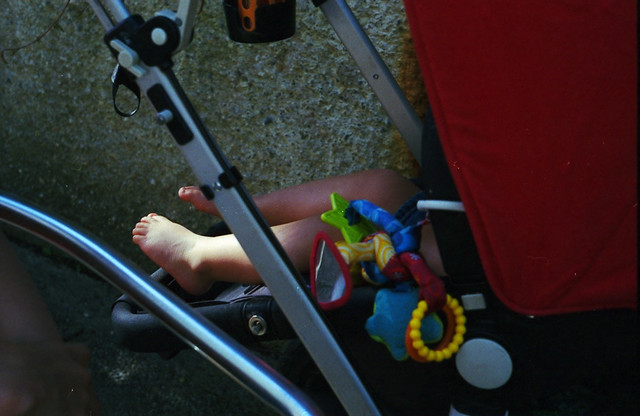
in the spotlight (20/52)
(Vitomatic IIa, Color-Skopar 50mm 1:2.8, Porst-Color-X 200, ISO 200/24°)

This year I shot a lot of sheet film using plate cameras: 6 sheets in 6.5x9 format (using both my Ideal 250/3 and my Bergheil 6.5x9) and 7 sheets in 9x12 format (with my Recomar 33). Again, there is great satisfaction in holding a huge 9x12 color slide sheet against the light and marvel at the level of detail that it can capture.

Another challenge that became a routine this year has been black and white film development. I developed 17 rolls/sheets of diverse brands of black and white film, all using the same film developer (Rodinal, in fact the oldest photographic product, still being produced after almost 125 years!) and mostly using stand development. There have been mixed results, the great part quite satisfying and some not so much. But I guess the not-that-happy ones were more about using very long expired film in poor lighting conditions than the development.
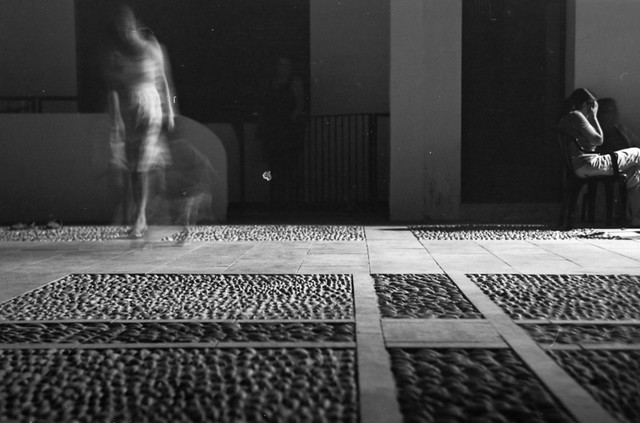
long toddler exposure
(Kiev 4, Jupiter-8M 50mm 1:2.0, Efke 25, ISO 25/15°, stand development 1.5 h in 1+100 rodinal)

I love the almost meditative mood one reaches on certain film development stages, especially in the final wash using the Ilford method: filling up the tank with water and performing slow inversions for 1, 2, 5, 10, 20 and 50 times each round, spilling the water and filling up the tank again each time between rounds. After that, the magical moment of opening the tank, and slowly unrolling the wet film from the reel to reveal the pictures that were latent until the chemicalthes did their job, is every time a personal highlight.

Another highlight this year has been in camera repairs. I started with my Rolleiflex Original 611, whose shutter needed attention. I managed to recover the sticky slow speeds and make the old rim set Compur shutter purr again happily even at 1 second. I, too, cleaned the optical path (inner side of the viewing lens, mirror and ground glass) as well as I could, which made the camera again quite usable. At last, I managed to clean and polish its leather, realizing that the brown spots that I thought were permanent did, in fact come out and left a shiny, beautiful camera that shouts quality from all its four corners. The Voigtländer Brillant V6 was a camera that I almost recovered to working condition from the trash can. I got it as a cheap addition to a lot (together with a Rolleicord V). Being a Voigtländer, even with a bakelite body, it is a well built and extremely well thought camera that responded very well to a little care. I fixed the film transport with film counter and automatic stop, and cleaned the waist-level finder and mirror to a crystal clear state I still can not believe. The Skopar 75mm 1:4.5 lens and the Compur shutter needed cleaning and service, too. All in all, I got lots of camera repair fun and a portable, usable camera that delivers a quality that is difficult to beat, all for what you would pay for a lunch in a standard restaurant.

The Ihagee Parvola 1350 needed, as usual, a little service in its Compur shutter. In this shutter I braved removing the slow speed escapament for the first time for properly cleaning it. It was my first time because on reinstallation one needs to adjust the shutter speeds again, because the position of this escapement determines the duration of the slow speeds. It was not easy, but at the end all speeds sound and look good enough for me. The Schneider Xenar 70mm 1:4.5 needed a little cleaning, too, and I lubricated the focusing helicals to make them run smoothly. Another first for me was adjusting a rangefinder: my Kodak Retina II needed a little lubrication and cleaning in the rangefinder, and after that the infinity setting needed to be adjusted again. I am still not quite sure if I got it right, I still have to check with critically focused shots, but it looks now clean enough to be used.
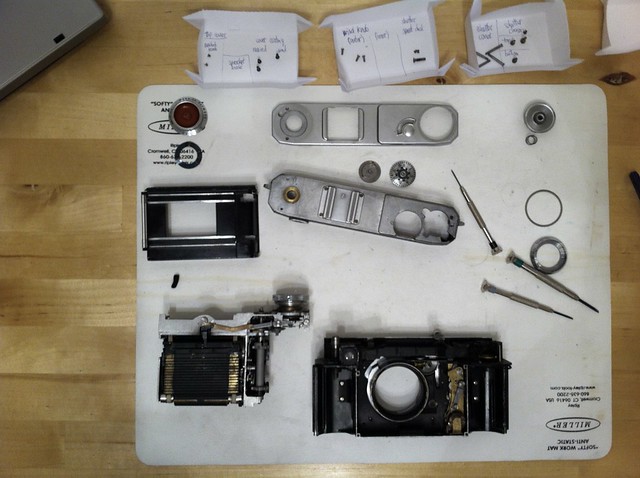
happy 4th analogversary!

My biggest repair this year, though, is still a work in progress. The Zeiss Ikon Contax II, one of the best cameras ever made and one that I am really happy to own. As I got it, neither the self timer nor the shutter did work. The Contax has a metal curtain focal plane shutter, a quite different beast from the leaf shutters that I am now quite familiar with. I opened it carefully and disassembled to shutter block from the camera body. A little cleaning, a little help and I managed to make it run a couple of times, with a purring and whizzing sound from its multiple escapements that made me think for a moment that I was about to succeed. But then the bane of this camera model set off. The Achilles' heel of every prewar Contax, and in fact the only thing that ever fails with a Contax, are the silk shutter ribbons that link together the opening and closing curtains. The shutter design is such that the ribbons slide through tiny eyelets on the opening curtain that have enough friction to hold it up as the shutter is cocked but allow sliding through when the shutter is fired and both opening and closing curtains are reeled onto the lower drums. These ribbons needed to be replaced every ten or twenty years, cameras were guaranteed for around forty thousands shutter operations. A camera that was built in 1936-1937, like mine, and that probably has been sleeping for decades, has had plenty of time for these ribbons to become dry and fray. Two or three shutter operations in my hands after such a long time was definitely too much for the old silk ribbons, that broke and left me with a much more serious repair job to do. Because, of course, these ribbons can be replaced. I already got the replacement silk ribbons from Japan (it seems to be one of the few ribbon type and material that properly work on a prewar Contax) but I still did not find the courage to delve again into the job. The Contax II shutter remains my biggest camera repair challenge for the next year. And if I manage to fix the non-working self timer along the way, I will be twice as happy.

The last successful camera repair job this fourth year has been a Vest Pocket Kodak from 1912, my oldest and most significant camera so far. The whole story of the Vest Pocket Kodak, on my last analgoversary post, coming soon...

(to be continued...)


Friday, December 12, 2014

Happy 4th Analogversary! (1/3)

Four years ago, on December 11th 2010, I posted my first film picture on flickr. This fourth year has seen the greatest increase in my vintage camera collection so far, to a point where I am beginning to think for a while when I am asked if I am a collector. In my heart I am not a collector, but an enthusiastic admirer and user of vintage cameras, that happens to enjoy satisfying the curiosity about this one or the other camera by getting them, making them work and taking photographs with them. But I know that the sheer facts tell another story, quite ironic if we consider what I said about the user/collector issue one year ago (collect less, take more pictures). Perhaps every collector started this way. Perhaps I am becoming a collector that enjoys using all his cameras, or at least tries to.

My commitment to the magic of film has not dwindled a bit. On the contrary, it is probably stronger than ever, especially now that I develop all my black and white films myself and I can witness the magic every time I open my daylight developing tank and pictures are revealed as I slowly unroll the film from the reel. In fact, I can hardly remember a single time that I photographed with a digital camera this last year. And not because I am one of those film nuts that see digital as evil: I do think that both are different tools and that each has its place, its strengths and weaknesses. I just happen to not have found neither chance nor the appropriate conditions to photograph with a digital camera.

In this fourth year I added many new old cameras to my stall. Most of them have a special meaning, they have certain historic or sentimental significance for me. In fact I am quite picky with my camera choice, there just happen to be too many interesting cameras out there to be discovered! :)

: : : (the honest collector's dilemma)

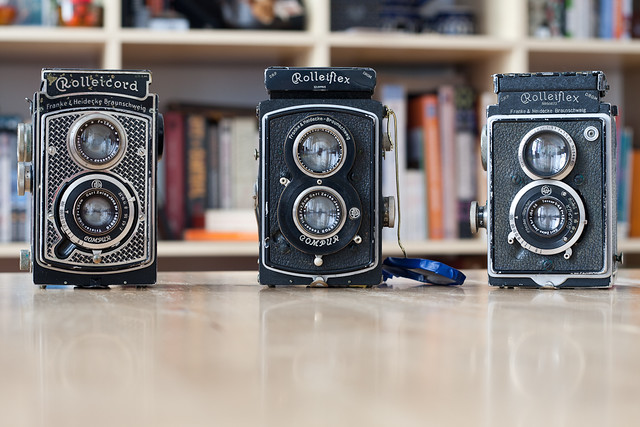
I got three TLRs made by Franke&Heidecke before WWII: the Rolleiflex Original 611 (1929), which is the grandmother and the cast of every single TLR that was to be produced in the following 60 years; the Rolleicord I Art Deco (1934), with its unusual and beautiful nickel cover, that brings one back to Midtown Manhattan in the late twenties; and the Rolleicord V (1954-1957), which combines convenience of use and remarkable contrast and sharpness from its Schneider Xenar lens.

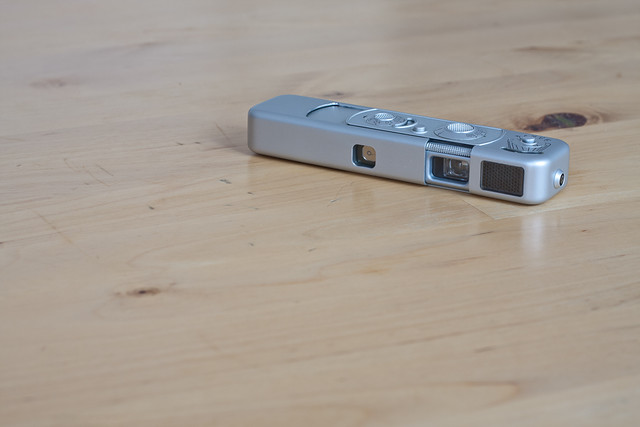
minox b (open)

There has been another bunch of new old cameras that I got out of pure curiosity: the Zeiss Ikon Contaflex (1953-1959), having both the convenience of an SLR and the quirkiness and feel of much older cameras; the subminiature Minox B (1968) with its 8x11 Minox film format that I did not really manage to master yet (but I keep trying!); the Ihagee Parvola 4x6.5 (1933) that is so enjoyable to use on 127 days and is so radically different in design from every other contemporary camera; the Voigtländer Brillant V6 (1937) that I got for next to nothing and which I managed to bring back to working order almost from the trash can and whose pictures, like everything Voigtländer, never ever deceive; and the Voigtländer Inos I (1933?), probably the most battered camera that I own, but worth every pain just for that magical Heliar lens.

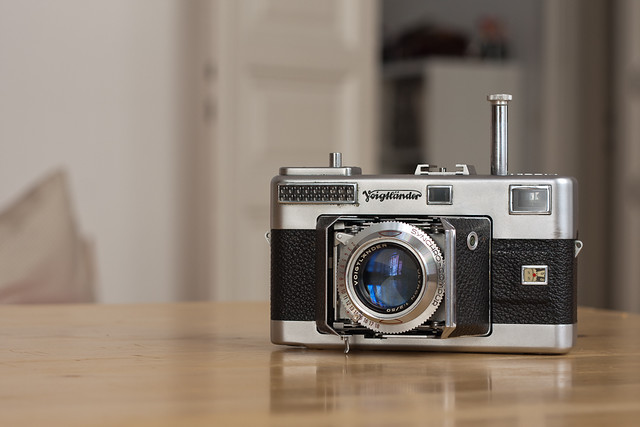
vitessa l

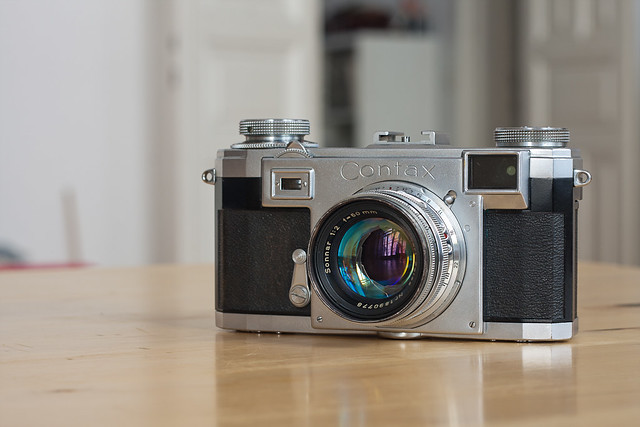
The camera family that has been definitely this year's highlight has been the 35mm rangefinders. It all started with a fascination for the history of the Zeiss Ikon Contax camera: the Kiev 4 (1962), which is a Contax in Soviet disguise has been, in fact, the camera that I used the most in this fourth year. Then came the Voigtländer Vitessa L (1956), for me one of the most elegant cameras ever made and one I am very happy to have not only because of its Ultron lens. A little later, thanks to patience and a bunch of good luck, I got a Zeiss Ikon Contax IIa (1952) well under its true value, without a doubt the camera that I enjoy the most. Then a Kodak Retina II (1949) because of the warm and wonderful Schneider Xenon lens and out of curiosity about the grandmother of our Retinette IA, the one with which everything began. The last addition this year, as it couldn't be otherwise, has been a wonderful Zeiss Ikon Contax II (1936-1937), which is still not working but which I hope I manage to bring back to life soon.

zeiss ikon contax IIa

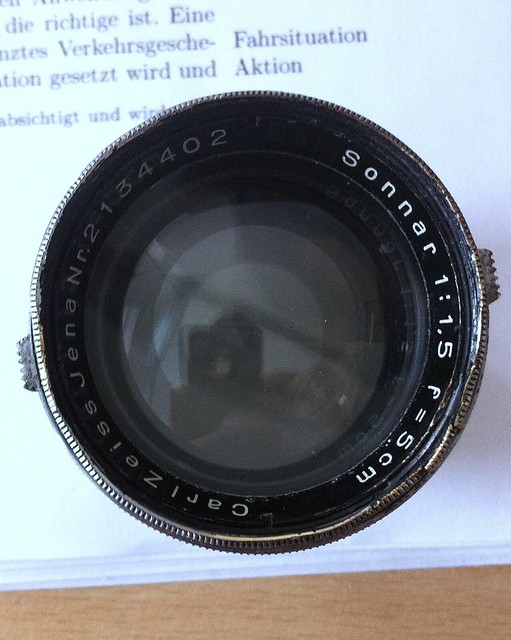
Several of my new old cameras have interchangeable optics. That, of course, opens the door to crave for lenses. In Contaflex mount I managed to find the Pro-Tessar interchangeable front lens elements to extend the standard 50mm Tessar to 35mm, 85mm and 115mm. In Contax/Kiev mount I quickly fell in love with Ludwig Bertele's Zeiss Sonnar formula: first through the Jupiter-8M 50mm f/2.0 (1962) on my Kiev 4, then through the postwar Carl Zeiss Sonnar 50mm f/2.0 (1953-1959) that is the West German recalculation of the original prewar formula. A Jupiter-9 85mm f/2.0 (1963) came along to explore the short telephoto range (which I am still learning to deal with), and a Jupiter-12 35mm f/2.8 (1959), a fine Soviet version of the legendary Zeiss Biogon, covers the wide angle. The latest lens addition, and in fact the lens that I see as my analogversary self-present, is a prewar Carl Zeiss Jena Sonnar 50mm f/1.5 (1937), an ultrafast lens that was the envy of every prewar Leica photographer, and that I plan to make the standard lens for my Contax II, if I manage to make it work. In the meantime I enjoy it on my Contax IIa.

happy 4th analogversary!

(to be continued...)

Friday, November 21, 2014

good luck [stranger 22/99]

good luck [stranger 22/99]
(Kiev 4, Jupiter-12, Kodak Elite Chrome Extra Color 100, ISO 100/21°)

My twenty-second stranger, fully equipped, was really committed to the business of bringing us good luck.

Sunday, September 28, 2014

Series - burggasse

The last year and a half we lived in the Burggasse in Vienna. This summer we moved to a new flat. This weekly series is a very personal recollection of the flat that we just left.

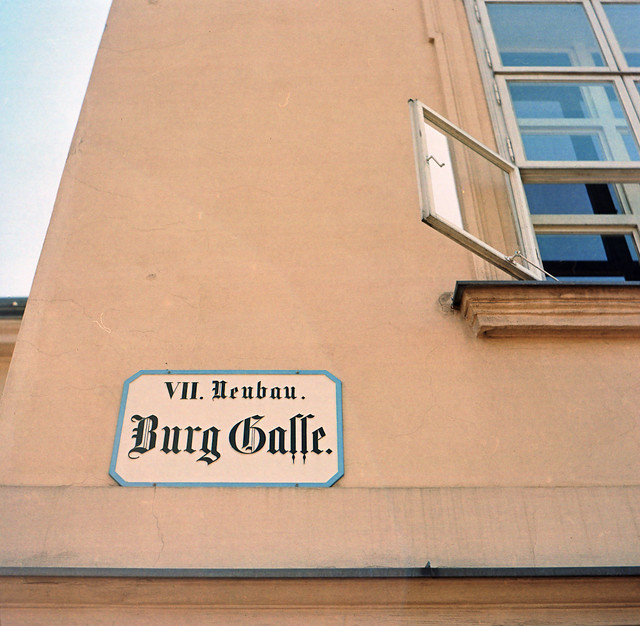
burg gasse
(Super Ikonta BX 533/16, Kodak Ektar 100, ISO 100/21°)

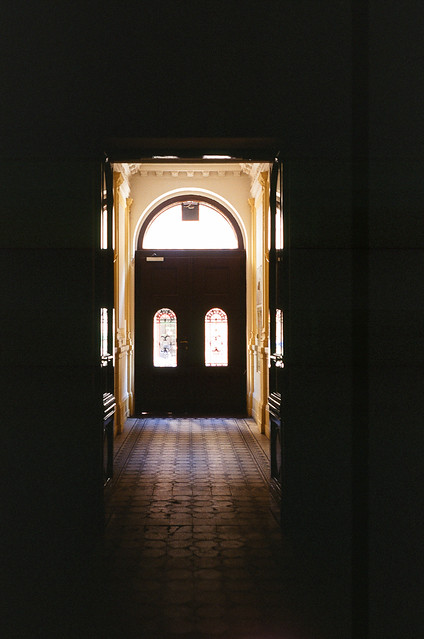
entrance
(Kiev 4, Kodak Elite Chrome Extra Color 100, ISO 100/21°)

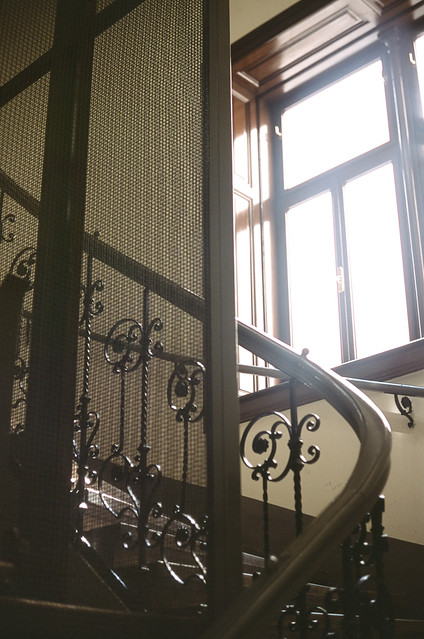
staircase...
(Vitessa L, Agfaphoto CT Precisa 100, ISO 100/21°)

x-pro stars
(Rollfilm 5x8, Rollei Crossbird 200, ISO 200/24°)

moldura
(Contaflex IV, Fujichrome Velvia 50, ISO 50/18°)

rainbow maker
(Contaflex IV, Fujichrome Velvia 50, ISO 50/18°)

caseta vella (33/52)
(Rollei 35, Solution Super VX 200, expired, ISO 200/24°)


Tuesday, August 26, 2014

A dream come true - Zeiss Ikon Contax IIa

After the bombing of Dresden in World War II, most of the Zeiss Ikon production facilities were destroyed. Everything was lost: machinery, tools, parts and plans. Gone was what had been Zeiss Ikon's 35mm flagship for the last 15 years, the Contax.

After the war, one branch of the story went to the Ukraine, where the Soviets took a rebuilt Contax production line for what was to become the Kiev camera. The other branch went to Stuttgart, where what remained of Zeiss Ikon in the West started anew in the old Contessa-Nettel production plant.

Zeiss Ikon Stuttgart soon started making finest and ingenious 35mm cameras (Contessa, Ikonta, Contina, later Contaflex, ...), especially thanks to Hubert Nerwin's genius. The Contax IIa (and its light metered sister IIIa) was a complete redesign of the prewar Contax II.

zeiss ikon contax IIa

My Zeiss Ikon Contax IIa was built in 1952 and belonged to a gentleman from Berlin, who was a professional musician and passed away only recently. The camera was found in his broom closet after decades of oblivion. Since in the eBay auction the word "contax" was nowhere to be found, it flew under the avid collectors' radars and allowed me to get it for a tiny fraction of its true value.

A little reluctant in the slow speeds at first, some exercise soon helped it fire more and more reliably, like the purebreed it is. Film transport and shutter tensioning has a buttery smooth quality to it that is a joy to operate. The lens, a coated Carl Zeiss Sonnar 50mm 1:2 shows pretty bad separation of the cemented glass elements (as revealed by the iridiscent reflections along the borders) but so far I haven't been able to see any serious impact on the pictures.

When it comes to vintage 35mm rangefinders, it hardly gets any better than this. I'm really happy :)

Zeiss Ikon Contax IIa
My Contax IIa flickr set

Maker Zeiss Ikon
Model Contax IIa 563/24
Type rangefinder system camera
Lens Carl Zeiss Sonnar 50mm f/2.0 (No. 1890778, 1953-1959)
Shutter Contax, 1 - 1/1250 + B + T
Film type 35mm 24x36
Year January-May 1952
Country West Germany