Showing posts with label vintage cameras. Show all posts

Friday, December 12, 2014

Happy 4th Analogversary! (1/3)

Four years ago, on December 11th 2010, I posted my first film picture on flickr. This fourth year has seen the greatest increase in my vintage camera collection so far, to a point where I am beginning to think for a while when I am asked if I am a collector. In my heart I am not a collector, but an enthusiastic admirer and user of vintage cameras, that happens to enjoy satisfying the curiosity about this one or the other camera by getting them, making them work and taking photographs with them. But I know that the sheer facts tell another story, quite ironic if we consider what I said about the user/collector issue one year ago (collect less, take more pictures). Perhaps every collector started this way. Perhaps I am becoming a collector that enjoys using all his cameras, or at least tries to.

My commitment to the magic of film has not dwindled a bit. On the contrary, it is probably stronger than ever, especially now that I develop all my black and white films myself and I can witness the magic every time I open my daylight developing tank and pictures are revealed as I slowly unroll the film from the reel. In fact, I can hardly remember a single time that I photographed with a digital camera this last year. And not because I am one of those film nuts that see digital as evil: I do think that both are different tools and that each has its place, its strengths and weaknesses. I just happen to not have found neither chance nor the appropriate conditions to photograph with a digital camera.

In this fourth year I added many new old cameras to my stall. Most of them have a special meaning, they have certain historic or sentimental significance for me. In fact I am quite picky with my camera choice, there just happen to be too many interesting cameras out there to be discovered! :)
: : : (the honest collector's dilemma)

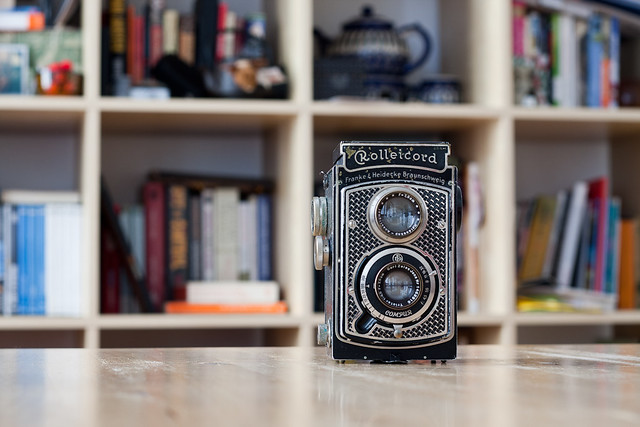
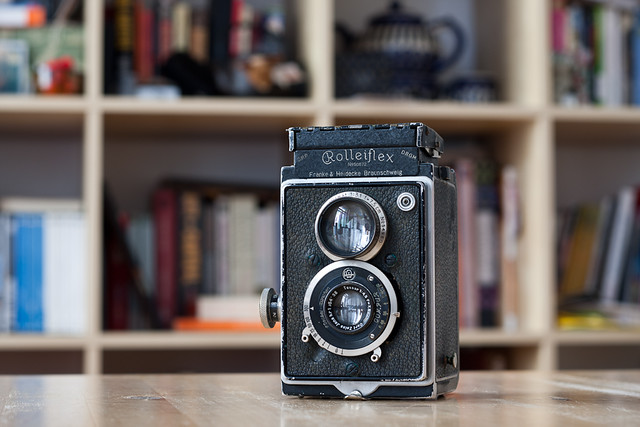
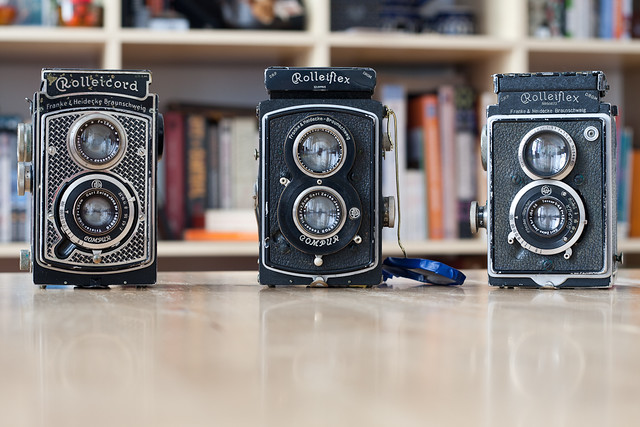
I got three TLRs made by Franke&Heidecke before WWII: the Rolleiflex Original 611 (1929), which is the grandmother and the cast of every single TLR that was to be produced in the following 60 years; the Rolleicord I Art Deco (1934), with its unusual and beautiful nickel cover, that brings one back to Midtown Manhattan in the late twenties; and the Rolleicord V (1954-1957), which combines convenience of use and remarkable contrast and sharpness from its Schneider Xenar lens.
minox b (open)

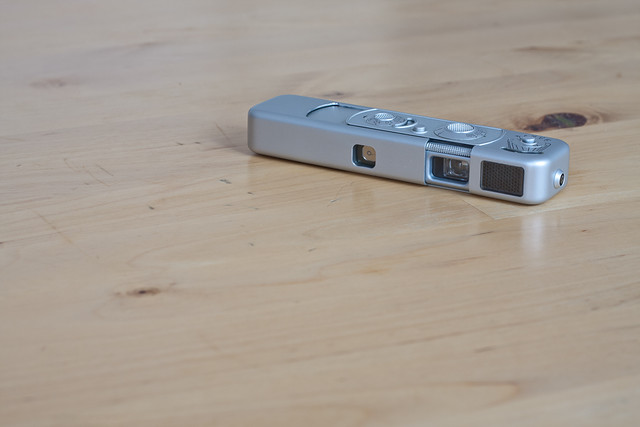
There has been another bunch of new old cameras that I got out of pure curiosity: the Zeiss Ikon Contaflex (1953-1959), having both the convenience of an SLR and the quirkiness and feel of much older cameras; the subminiature Minox B (1968) with its 8x11 Minox film format that I did not really manage to master yet (but I keep trying!); the Ihagee Parvola 4x6.5 (1933) that is so enjoyable to use on 127 days and is so radically different in design from every other contemporary camera; the Voigtländer Brillant V6 (1937) that I got for next to nothing and which I managed to bring back to working order almost from the trash can and whose pictures, like everything Voigtländer, never ever deceive; and the Voigtländer Inos I (1933?), probably the most battered camera that I own, but worth every pain just for that magical Heliar lens.
vitessa l

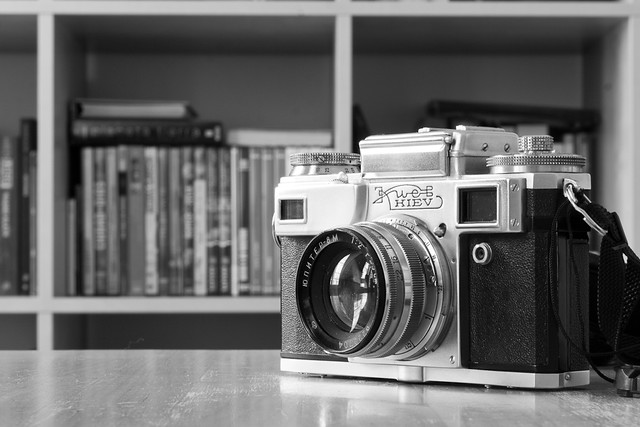
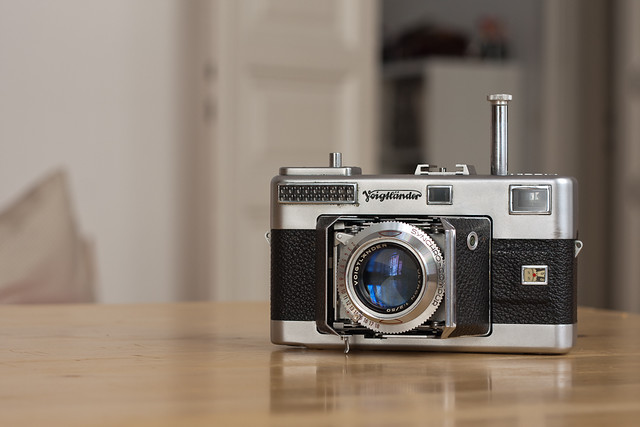
The camera family that has been definitely this year's highlight has been the 35mm rangefinders. It all started with a fascination for the history of the Zeiss Ikon Contax camera: the Kiev 4 (1962), which is a Contax in Soviet disguise has been, in fact, the camera that I used the most in this fourth year. Then came the Voigtländer Vitessa L (1956), for me one of the most elegant cameras ever made and one I am very happy to have not only because of its Ultron lens. A little later, thanks to patience and a bunch of good luck, I got a Zeiss Ikon Contax IIa (1952) well under its true value, without a doubt the camera that I enjoy the most. Then a Kodak Retina II (1949) because of the warm and wonderful Schneider Xenon lens and out of curiosity about the grandmother of our Retinette IA, the one with which everything began. The last addition this year, as it couldn't be otherwise, has been a wonderful Zeiss Ikon Contax II (1936-1937), which is still not working but which I hope I manage to bring back to life soon.
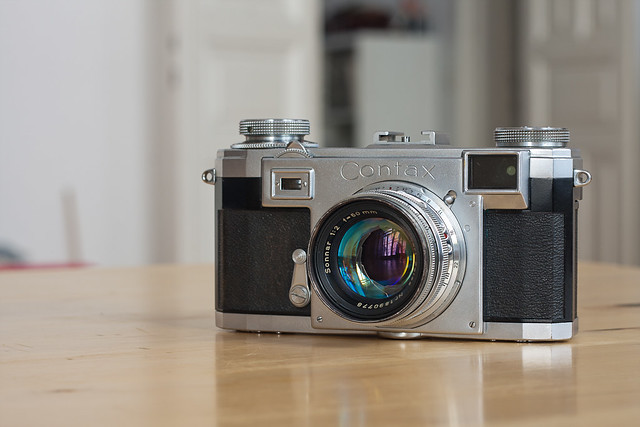
zeiss ikon contax IIa

Several of my new old cameras have interchangeable optics. That, of course, opens the door to crave for lenses. In Contaflex mount I managed to find the Pro-Tessar interchangeable front lens elements to extend the standard 50mm Tessar to 35mm, 85mm and 115mm. In Contax/Kiev mount I quickly fell in love with Ludwig Bertele's Zeiss Sonnar formula: first through the Jupiter-8M 50mm f/2.0 (1962) on my Kiev 4, then through the postwar Carl Zeiss Sonnar 50mm f/2.0 (1953-1959) that is the West German recalculation of the original prewar formula. A Jupiter-9 85mm f/2.0 (1963) came along to explore the short telephoto range (which I am still learning to deal with), and a Jupiter-12 35mm f/2.8 (1959), a fine Soviet version of the legendary Zeiss Biogon, covers the wide angle. The latest lens addition, and in fact the lens that I see as my analogversary self-present, is a prewar Carl Zeiss Jena Sonnar 50mm f/1.5 (1937), an ultrafast lens that was the envy of every prewar Leica photographer, and that I plan to make the standard lens for my Contax II, if I manage to make it work. In the meantime I enjoy it on my Contax IIa.
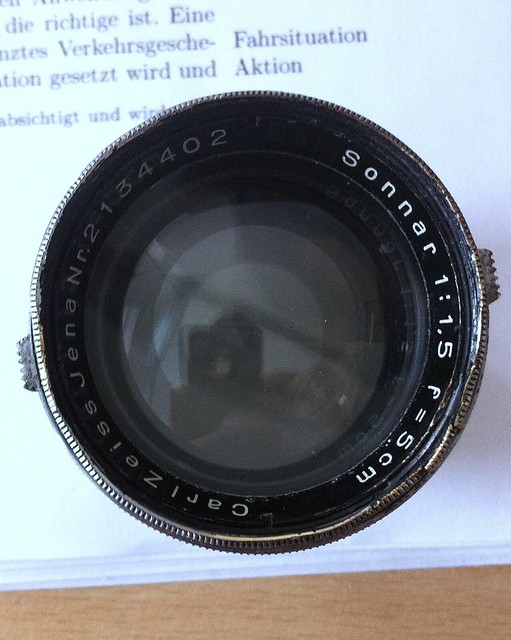
happy 4th analogversary!

(to be continued...)

Thursday, June 26, 2014

The honest collector's dilemma

As I stated before, I do not really see myself as a vintage camera collector but as a vintage camera user.

I enjoy taking pictures with old cameras, marvel at their ingenious designs and elegant shapes and never cease to be amazed by the optical quality they are capable of delivering even though many of them are well past the 80-year-old mark. This enjoyment has a consequence: I research and read a lot about cameras, the history of camera makers and the lives and achievements of the key persons that brought camera and optical design to the point where it is now. And this consequence has a side effect: For many of the cameras I read about (and that I do not own), I develop great curiosity about how they feel like in the hand, how it is to operate them, what kind of pictures they are capable of rendering.

Out of this curiosity, and also for the sheer enjoyment of looking at pictures of vintage cameras, I use to scout vintage camera listings on eBay, online and offline camera dealers and other platforms where people sell stuff. It is usually a void exercise, since I rarely buy anything, but it helps develop a sense for the sale prices of many cameras and related photographic gear. And, every once in a while, a listing pops up where the price asked is only a fraction of the true value of the article.

One of the standard scenarios for such a bargain to be found happens when the seller, typically knowing very little about vintage cameras, finds herself with a camera in her hands, usually left by someone else (typically a parent, grandparent or friend) and does not know what to do with it. Old cameras tend to be regarded as useless paperweight by many people, especially if their condition is not very good. Since the advent of digital photography, even a 35mm camera (for which film is easily available) is seen as something obscure and obsolete, with little chance to be used again.

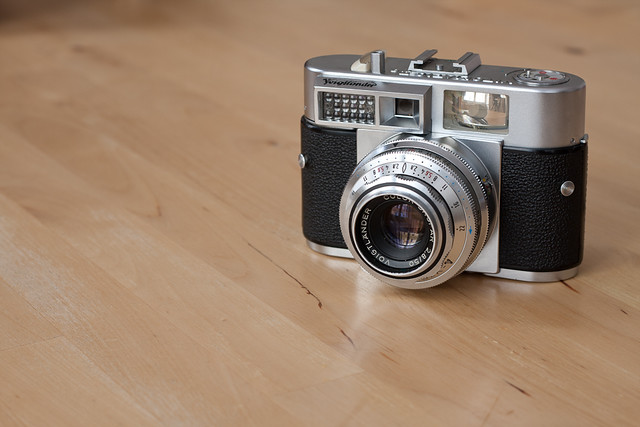
voigtländer vitomatic IIa

I have been lucky (or watchful) enough to have scored a number of such bargains. The first one was my Voigtländer Vitomatic IIa. The seller found it in a closet. It belonged to her grandfather and she had no idea how it worked (in fact, the ad described it as a single lens reflex camera). She was sure that it had rested there for the last twenty years. Complete with its leather case, first it did cost 15€. I silently watched the listing for a couple of weeks, after which the seller cut the price down to 10€. This was an offer I could not ignore anymore. I really wanted to have another Vitomatic, even more one with a rangefinder, and this one was being sold for approximately one eighth of the price indicated by reputable sources. Upon camera arrival, sure enough, the slow speeds did not work properly, but this is a repair that I think I will be able to manage. In the meantime I can live quite comfortably shooting over 1/25. And, of course, in case I botched the repair, not much (economically) would have been lost.

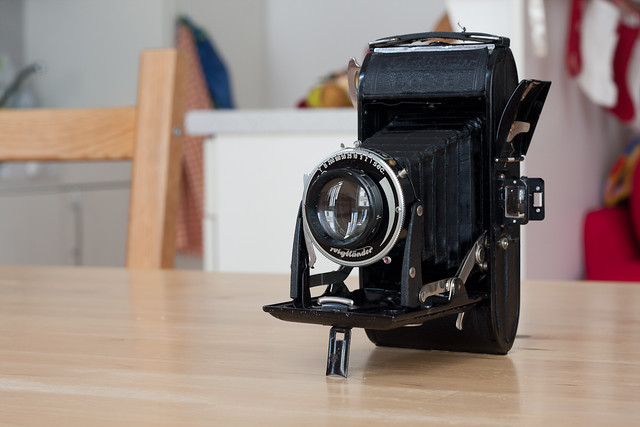
voigtländer bessa 6x9

In a similar way I got a Voigtländer Bessa 6x9 medium format folder, a Rolleicord I Art Deco 6x6 twin lens reflex, a Kiev 4 35mm rangefinder, a subminiature Minox B and a Zeiss Ikon Contaflex IV leaf-shuttered single lens reflex, all well under one fifth of the collector's price. I already exposed many films with them. The Kiev might, in fact, be the one I'm going to use the most in this 2014, because I really love using it and the way it feels in my hands.

rolleicord I "art deco"

kiev 02

But perhaps the most spectacular camera deal, and the one that made me think about writing this post, has been a 1929 Rolleiflex Original 611, the first mass marketed twin lens reflex camera, the one that started the Rolleiflex legend and the long TLR golden age. Every TLR model that was to be built in the following 60 years, and there were hundreds of them, was basically an Original Rolleiflex in disguise.

rolleiflex original 611

I paid 30€ for this Rolleiflex. Collector prices start at around 300€ for a moderately battered exemplar, because of their historical significance and also because not many of them were built. The seller, a soft-spoken elderly gentleman living in the outskirts of Vienna, got it from the estate of a recently deceased acquaintance. He was genuinely fascinated by the fact that I planned to put this camera into use. The camera came with the original leather case, lens caps, lens hood and yellow filter. I could sense the loveliness and care of the original owner in the way how the yellow filter was protected by a cloth wrapped inside the lens hood, all neatly stuffed in a leather pouch attached to the camera case. This camera was used and loved for a long time. Although it is the early model (the detachable non-hinged back reveals it), a focusing knob with distance scale from the later model replaced the original one. The flash synchronization contact (on the upper right of the front standard) was obviously a much later upgrade.

The shutter, as usual, is a little reluctant on the slower speeds, and one of the brackets supporting the viewfinder hood needs minor fixing. All in all, nothing that scares me or makes the camera unusable. Glass and mirror are clean and film transport works smoothly. The seller was very happy to see that I was going to use the camera ("Sie wollen damit wirklich fotografieren!", "You really want to take pictures with it!", he kept saying). He was happy with the money he got, and I was happy with the price I paid. In fact, on my way back home I could not believe my luck.

And yet, on the next days and weeks I started thinking about how the seller could have easily got at least 200-250€ for this camera, had he brought it to any of the specialized vintage camera dealers in Vienna. He obviously did not know that, he did not know the real value of the Rolleiflex, and I did. And somehow, I began to feel bad, I began thinking if it had not been dishonest of me to pay him just the amount he asked out of ignorance. Would it have been better to tell him: "Look, here's 200€, which is much closer to what this camera is really worth"? And yet, he was happy and I was happy. Is it not the definition of a win-win situation?

This thought comes to my mind every time I find such a deal. The honest collector's dilemma. Be honest and teach sellers about the true value of a camera? Or keep the knowledge to yourself and obtain valuable cameras at a fraction of their price? What do you think?


Wednesday, December 11, 2013

Happy 3rd Analogversary!


Three years ago, on December 11th 2010, I posted my first film picture on flickr. Three years later I continue taking pictures almost exclusively on film and I still enjoy using old cameras for it. Although this third analogic year has seen a strong decline in the number of films that I put through my cameras and to the number of posts in this blog as well, there has been no decline in my commitment. I guess the reduced action has probably more to do with rising our one-year-old son, an enterprise which unfortunately (or maybe gratefully so) does not leave one with many opportunities to take pictures, especially with certain cameras.

I am happy this year because I kept on doing my own camera repair and servicing and, although not always with a happy ending (the film advance in a Contina Ia is still waiting for my fourth attempt), I've managed loosing the fear and feeling almost comfortable around dismantled shutters and the smell of lighter fluid.

In this third analogic year I shot 32 rolls of film (13 black&white, 12 color negative and 7 color slide) using 16 different cameras. The camera that I used most often has been a new acquisition: I shot 6 rolls with an Exakta Varex IIa that I got looking for the origin of those uncountable many SLRs with interchangeable optics that we have today (and that already existed yesterday). The discovery of the Exakta has been probably one of the three highlights in camera collecting this year. I do not see myself as a camera collector but as a camera user, because I really use all my cameras, and acquire them solely with the purpose of using them. Nevertheless, I guess to compensate inconsciously for not being able to photograph as much as I wanted to, this year I ended up acquiring a little more cameras and especially accessories than I used to in the past. Living now in Vienna and having a much easier access to many sources of cameras and gear has for sure been another factor. As I said, my Exakta outfit with four lenses and two viewfinders is proof of that.

exakta family

The second highlight has been undoubtedly the resurgence of Voigtländer. I have always been a deep admirer of the fine cameras and lenses coming from Brunnswick. In fact, the Heliar f/4.5 lens on my Rollfilm 5x8 was my self-given gift for my first analogversary. Ever since then, I dreamed about owning the second variant, Heliar f/3.5, but unfortunately the price tag on them were just too much for me and my moral. This fall I had the chance to acquire this lens, attached to a most wonderful Bergheil 6.5x9 plate camera, for a very reasonable price. And then I remembered just how much of a jewel these cameras are and why do I love them so much. Later on I was able to secure a Vitomatic IIa 35mm rangefinder camera (I already owned a non-rangefinder Vitomatic Ia and gave it away) and a Bessa 6x9 rollfilm camera (which I always wanted) both for ridiculously low prices, ending up with a nice happily growing Voigtländer family.

voigtländer family

The third highlight, though, is the one that makes me the most happy. Last year I already wrote about my quest for a camera made in 1912, a camera that would be 100 years older than our son. There have been a number of candidates and near-hits this year: a Vest Pocket Kodak that ended up being autographic and thus some years younger, an Icarette 6x6 from 1918, a much battered and ugly Ansco Vest Pocket No. 1 which could be it but I suspect it to be from a little later, ... Last month I got a non-autographic Vest Pocket Kodak, the camera that many American soldiers (ilegally) had in the trenches during World War I. The production run of the non-autographic VPK is quite short, 1912-1914.

vest pocket kodak, 1912-1914

My camera has a fairly low serial number, around 30000, although serial numbers seem not to be a very reliable dating feature for Kodak cameras. I guess I'll never be completely sure if this camera was indeed built in 1912, but I like to think that chances are good. I will try to make this camera fit to take pictures again. It won't be easy, since the body seems to be bent sideways and the camera does not close properly. The shutter is almost working (still have to figure out how can an actuating lever be a fraction of a millimeter shorter than it should) and the receded meniscus lens looks fine.

For my next analogic year I will try to photograph a little more and collect a little less. We recently got a scanner that can properly handle film up to medium format. Until now I have been digitizing my pictures basically by taking a backlit digital picture of the negative. Not comfortable and definitely not fun, especially when it comes to inverting colors by hand in the computer. This year I let my lab scan many films and many others are still patiently waiting to be digitized. There's going to be some learning about scanning film properly this next year. But the photographic challenge I am most excited about is to do my own film development. For my birthday Mar got me a film development starter kit, with a daylight tank, a thermometer, bottles and everything I need. I plan to start with black&white but I still need to do a little research about chemicals and options. And, yes, there is also this very exciting caffenol development thing... :)

I hope that you keep sharing this photographic journey with me! :)

Wednesday, December 12, 2012

Happy 2nd Analogversary! :)

Two years ago, on December 10th 2010, I posted my first film picture on flickr. One year ago, I already celebrated my first "analogversary". Today, one year later, here I am, still going strong on my commitment to film photography with vintage cameras.

This second year has been one of more mature camera choice and use, in general a year of more thought of photography. All in all, I exposed 71 films (22 black and white, 32 color negative, 17 color slide) using 14 different cameras. The camera that I most often used was my Rolleiflex Old Standard 621 (18 rolls). The color negative film that I most used was again Kodak Portra 400 (8 rolls), for black & white Kodak Tri-X 400 (3 rolls) and on color slide Fujichrome Velvia 50 remained a favorite (5 rolls).

In this year I got 5 new (old) cameras (Rolleiflex, Contessa, Ikonta, Super Ikonta BX and Rollei 35). In order to balance the energy, I also gave 5 cameras away (Polaroid, Vitomatic, Flexaret, Beltica, Hapo). As it seems, I am taking a more mature stand to vintage camera use, since I only got cameras that have some kind of significance, some meaning.

Another reason I am happy with my second analogue year is that I managed to accomplish one of the challenges that I set myself last year: doing my own camera repairs, which is a natural step when the objects you are trying to work with are (almost) all many years older than your parents. I got tons of patience, some specialized tools, and lots of information and good advice from websites and flickr pals. I managed to recover all speeds of the Compur shutter on my Rollfilm 5x8, to repair the jammed film transport in my Contessa 533/24 and to lubricate the focus system and recalibrate the rangefinder on my Super Ikonta BX 533/16. Oh yes, and there were some fun experiments with junk Compur shutters, too... :)

I will definitely keep photographing on film with vintage cameras next year. My next project, though, has all the meaning of the world for me: 6 weeks ago Mar gave birth to our first born. Long before I could hold him in my arms, I thought I would try to find a camera from 1912, a camera 100 years older than our child.

happy 2nd analogversary! :)

This camera, a Vest Pocket Kodak, could have been the one, since it was introduced in 1912, like the 127 film that it takes (and it fact, 127 film was especially designed for this camera). Some of its features (lens, body finish, autographic feature, engraved patents), though, point it to a little later (1921-1926).

The quest, thus, is still open. I'll be happy if you keep sharing this journey with me! :)

Saturday, December 10, 2011

Happy Analogversary! :)

One year ago, I published my first film picture on flickr. In fact, I had already posted a couple of shots taken with the Diana Mini, but it was with this picture, taken with the Kodak Retinette IA, that I realized that film photography was truly something worth spending my energy and devoting myself to, that it could replace and multiply the joy that I got from digital photography. Film photography became, thus, a project on its own.

analogue makartsteg
(Retinette IA, Kodacolor 200, ISO 200/24°)

For me, this picture represents the beginning of an amazing year, photographically speaking, rich in surprises and full of fun and learning. In this year I published almost 300 film pictures to my flickr photostream, from them 120 on black and white film, 90 on color negative film and 90 on color slide film.

I exposed 86 films: 38 on 35mm format, 45 medium format, 2 film sheets and 1 instant film pack. The most used black and white film is tied between Kodak Tri-X 400 and Ilford FP4 Plus 125 (both 3 rolls). The most used color negative has been Kodak Portra 400 (4 rolls) and the most used color slide film Fujichrome Velvia 50 (9 rolls).

I used 12 cameras: six 35mm cameras, four medium format cameras, an (almost) large format camera (Ideal 250/3) and an instant film camera. The one that I used the most has been my beloved Flexaret VI, with which I exposed 25 films this year.

How much did I learn this year? Really a lot, but hopefully not half of what I am going to learn next year. Because my head is boiling with new challenges and exciting projects! :) Thanks for sharing this journey with me! :)

Wednesday, June 15, 2011

Attachment

There is a strange connection between a photographer and his or her camera.

The longer a camera is used, the stronger the fondness the photographer feels for it grows. If you really enjoy using a camera and you take a lot of pictures with her, it ends up being kind of an extension of your arms, your fingers, your mind and your soul. I guess it is because a camera is like a musical instrument: an inanimate object that accomplishes a key part in the expression of a feeling, which opens a new chance for people to communicate.

I believe every photographer transfers a bit of her or his soul to the camera. And I think this is also one of the reasons for the fascination about old second hand cameras. I like to make imaginary journeys to the past and try to know which hands used our cameras before mine. My Flexaret, for example, could have been bought by Pavel, a Czechoslovak journalist living in Prague by the end of the 60s, although he originally came from Bohemia. Our EOS 40D could have belonged to Lukas, a young hobby photographer living in Linz, who sold it when he decided to get a 5D to try and start a new career as a professional wedding photographer. Or my Hapo, that could have been owned by Helga, a Bavarian woman living in a small town close to Nürnberg by 1959, who wanted to have her own camera and got it in the mail from Photo Porst's catalogue. She had to cope with the laughs of her husband, who was a heavy smoker. Helga, though, showed a very insightful eye for photography since the very first moment she started shooting with the Hapo. Its leather case became impregnated with the smell of her husband's cigarettes, which would not vanish for decades.

On our last visit to Munich I took the chance to look around a couple of second hand camera shops. As I entered F&S in the Herzogspitalstraße (which looks like a watchmaker's, only with tons of cameras and lenses from the last hundred years piled on the shelves) there was this elder gentleman in front of me who, as I quickly realized, was not buying anything but trying to sell a camera to the store owner.

schaufenster
(Flexaret VI, Ilford XP2 Super 400, ISO 400/27°)

The camera was a nice looking Rolleiflex TLR sporting f/2.8 lenses. The old man took it carefully from the leather case and, trying to conceal a slight shake of his hands, handed it over to the store owner, who took it roughly and examined it with the look of a professional poker player. He quickly opened the back and, releasing the shutter in B mode, held the 'flex up against a light to examine the lens. He then proceeded to put it down and told the man that the lens had a scratch and that he could only give him 50€ for the camera. The man looked shocked and told him it was a very fine camera, and asked him how much would he sell it for afterwards. The store owner did not answer and gave the 'flex back to the old man and, looking at me and ignoring him, asked me what I wanted. The old man, visibly annoyed, put the camera back in its case and left the store.

I asked the store owner to show me one of the cameras from the shop window but, probably because of the scene I just witnessed, I decided to bring my business elsewhere. I had a strong gut feeling that someone capable of offering 50€ for a camera that he could then easily sell for more than 200€ was not really someone to be trusted.

I walked down a couple of blocks to another shop that I already visited in the morning. As I reached the counter, I asked one of the salesmen for the article I wanted (*), which was exposed in a quite hidden showcase. As we returned to the counter, I looked to my left and saw the same gentleman already taking his Rolleiflex out of its leather case. He was showing it to another salesman, who was shaking his head negatively. Then the old man told him that he also had a big collection of Nikon lenses, “just like the ones you have back there!”, and if they would take them.

I felt deeply sorry for the old man. Judging by the extreme care he showed when taking his camera in and out of the leather case, I guessed selling it had been no easy decision for him: the 'flex had clearly been a source of enjoyment in the past. I tried to imagine the happy memories that this camera brings to the old man's mind. This thought made me sad and even angrier at how the other store tried to rip him off.

The man then slowly put his 'flex back into the leather case and the whole thing in a white plastic bag and turned around to leave this store with no success, too. As he walked past me, our eyes met and for an instant a crazy thought crossed my mind, but then I reminded myself I already have a TLR, which, in fact, was hanging from my neck the whole time!

I really wish the old man finds a honest buyer for his Rolleiflex, one that appreciates its true value, both material and sentimental.

(*) in case you're wondering what did I eventually bring home from Munich, well, you'll still have to be a little patient... ;)

Thursday, June 2, 2011

Guest Cameras - Zeiss Ikon Super Ikonta A 531

If there is a name that every vintage camera lover should know and revere, it is that of Carl Zeiss. Even today, this name stands for ingenious optics discoveries, finest German craftsmanship and top quality lenses. Zeiss was, in its heyday before and after World War II, a huge conglomerate that dominated (and almost monopolized) the camera and optics market for decades. Zeiss's camera division produced cameras under the brand Zeiss Ikon.

Recently I had the chance to run a roll of film through one of the finest cameras ever produced by Zeiss Ikon, a Super Ikonta, which my mother-in-law received as a present from an acquaintance that did not want it to get lost when she died, and that my sister-in-law is beginning to use these days.

guest cameras - zeiss ikon super ikonta A 531
(EOS 350D, EF 50mm f/1.8, 1/13, f/5.0, ISO 800)

The Super Ikonta A 531 is a medium format folder camera that takes pictures in 6x4.5 format on 120 roll film. It sports a Carl Zeiss Tessar 75mm f/3.5 lens, which is also a legendary lens designed by Paul Rudolph in 1907 while working for Zeiss. The Tessar lens design was copied by virtually every lens maker for years and years. The Super Ikonta 531 was produced from 1937 to 1956. The exemplar that I used was made between 1952 and 1956, since these are the only Super Ikontas with a Synchro Compur leaf shutter.

tarongers
(Super Ikonta A 531, Fomapan Creative 200, ISO 200/24°)

The most ingenious feature of a Super Ikonta is its coupled rangefinder (in fact, this is exactly what makes it a Super Ikonta instead of a regular Ikonta). A rangefinder is a device that allows measuring the distance to the subject so that you can set the focus right on the lens. To operate a rangefinder, two superposed images have to coincide on the subject you want to photograph. With an uncoupled rangefinder, the photographer should transfer manually the reading from the rangefinder to the lens; with a coupled one the focus distance is automatically transfered to the lens. In the Super Ikonta, a small auxiliary lens pops up from the lens itself and moves forward and backward with the focusing of the lens. The image going through this auxiliary lens has to coincide with a second one in the rangefinder by means of turning the focus ring on the lens. There is no need for a complicated mechanical transfer from the camera body to the lens: light, optics and genius are enough to do the job.

Having a new old camera in your hands is a real joy, because you have to figure out how to operate it, and in this process you come closer to the clever minds that conceived and designed it. It makes you realize what a long path camera development has already left behind, how many standard features we assume without questioning. The shutter release of the Super Ikonta, for example, has to be operated with the left hand instead of the standard right hand operation of today's cameras. Of course, it takes a while to get used to.

storefront
(Super Ikonta A 531, Fomapan Creative 200, ISO 200/24°)

Like in most medium format folder cameras, the film has to be advanced using a red window. That means a little window opens on the back of the camera and the film has to be advanced by turning a knob until the next frame number appears in the window. 120 roll film has a paper back with guide frame numbers printed on it for the different formats it can take, namely 6x4.5, 6x6 and 6x9. Other cameras have a more modern film advance mechanism that automatically blocks the spool when the next frame is in place.

On the Super Ikonta, the film advance knob has a double exposure prevention mechanism as well, that blocks the shutter release until the film has been advanced. In this exemplar, though, the mechanism got jammed from time to time and did not unlock the shutter release even though the film had been correctly advanced to the next frame. But this is not a real problem when using folder cameras, because there is always a direct release on the shutter itself, which is activated more or less cleverly from the shutter release on the camera body. For some of the pictures I had to press a small lever at the bottom of the shutter, but that's also part of the fun.

electricity sunset
(Super Ikonta A 531, Fomapan Creative 200, ISO 200/24°)

The Super Ikonta I had the honor to use is a really well preserved exemplar (considering it was made more than 50 years ago!), and even though the Tessar lens could use a thorough cleaning between the elements, it still produces astonishingly sharp pictures. All shutter speeds seem correct, even the slower ones, and except for the occasional jamming of the double exposure prevention, the camera works with a smoothness and precision one can only marvel at. Once again, I wonder how would any of our fancy dSLRs perform in the year 2060...

Maker Zeiss Ikon
Model Super Ikonta A 531
Type Folder
Lens Carl Zeiss Tessar 75mm f/3.5
Shutter Synchro Compur 1 - 1/500 + B
Film type medium format (120), 6x4.5
Year 1952-56
Country West Germany

Sunday, May 22, 2011

Meterless exposure

I once read a story, probably apocryphal, about an interviewer who asked Henri Cartier-Bresson, the legendary street photographer, if it was true that he did not use a light meter to get his exposures. Cartier-Bresson said it was true and, to prove it, proceeded to give two exposures (shutter speed and aperture for a given ISO film speed), one for the left and one for the right side of the interviewer's face, which was lit from the side. Both exposures turned out to be correct.

The ultimate challenge when using vintage photographic cameras is that they usually predate the automatic exposure era. The problem of determining exposures has to be faced by the photographer alone, and this is one of the reasons why I love them. As I began photographing with the Retinette I thought about getting a light meter. At first I even took one of our dSLRs with me to measure, and then transferred shutter speed and aperture settings to the Retinette, but this was kind of using a can(n)on to kill a fly... ;) Then I came across Fred Parker's ultimate exposure computer, which was exactly what I was looking for: a (relatively) easy way to determine exposure without the need of a light meter, using nothing more than your eyes and your brain.

The main idea is to estimate the amount of light falling into a scene. This is the only input required: everything else is known or can be decided creatively. The amount of light is measured by a magnitude called exposure value (EV). Our eyes and our brains are indeed perfectly capable of estimating exposure value, one just needs a little practice and some reference points. For example, a typical scene in bright direct sunlight has an exposure value of EV15. A direct light in heavy overcast or an area in open shade with clear sunlight needs EV12. The light with a clear sky one hour after sunrise is EV9-11. A home interior in artificial light is EV5-7. And so on.

dandelions
(Retinette IA, Fujicolor Superia Reala 100, ISO 100/21°)
This one was shot at EV14, since the sun came from one side, on an ISO 100 film. I set 1/125 and went one step down the EV scale to an f/11 aperture.

Once the exposure value has been estimated, determining the aperture and shutter speed is quite easy if you use the sunny f/16 rule as an anchor point. This rule states that EV 15 (corresponding to bright direct sunlight) requires approximately the reciprocal of the ISO speed for the shutter at f/16. If you are using ISO 100, then 1/125 @f/16 is the nearest setting; for ISO 200 it would be 1/250 @f/16 and for ISO 400 it would be 1/500 @f/16.

lehener brücke crop
(Flexaret VI, Kodak Tri-X 400, ISO 400/27°)
This picture was shot at EV15 on an ISO 400 film. I set the shutter speed to 1/400 (maximum in the Flexaret) to freeze the movement as much as I could, since I was walking. The sunny f/16 rule required an aperture of f/16.

Both shutter speed and aperture (f-number) scales are calibrated for each stop to be exactly one EV point. This makes using the sunny f/16 rule very easy. Suppose we want to shoot a scene at EV12 and we have ISO 200. Now EV15 would mean 1/250 @f/16, but we want to go 3 stops down to EV12. Now we could go three units down in any dimension: keep shutter speed at 1/250 and set aperture to f/11 (-1EV), f/8 (-2EV) and finally f/5.6 (-3EV = EV12, our target), or you could keep aperture at f/16 and reduce shutter speed to 1/125 (-1EV), 1/60 (-2EV) and 1/30 (-3EV = EV12, again our target). A combination of both is of course possible: 1/125 @f/8 (-1EV in shutter speed and -2EV in aperture) and 1/60 @f/11 (-2EV in shutter speed and -1EV in aperture) would both expose correctly for EV12.

In this way, you can always decide an aperture first (for depth of field considerations) and then determine shutter speed and ISO for the scene. Or start with the shutter speed (to freeze a moving subject, for example) and determine aperture and ISO later. The ISO speed scale is calibrated in EV units as well. The step from one ISO speed to the next is exactly 1 EV. For film users like myself ISO speed is something that you cannot change easily from picture to picture, but it is no problem if you use a digital camera.

chairs
(Praktica BMS, Prakticar 50mm 1:1.8, Fuji Neopan 100 Acros, ISO 100/21°)
The film was an ISO 100 and I estimated EV11 for this one. I set shutter speed at 1/125 to minimize camera shake and that left me with an f/4 aperture.

I find it very useful to learn the most usual ranges of aperture and shutter speed scales by heart (*), because cameras (especially the older ones) do not always stick to the standard EV stops, especially on technically challenging matters like maximum aperture or maximum shutter speed.

lights and shadows
(Hapo 66-E, Kodak Tri-X 400, EI 800/30°)
I was shooting this film at an exposure index of 800 (like an ISO 800). My exposure value estimation was EV7. I set the aperture to the maximum the Hapo can go, f/3.5, for which I needed 1/50 on the shutter speed.

I admit that it might look difficult at first, but it is true that with a little practice you will be estimating exposures in no time. This way you can avoid having to rely on light meters, which have many problems and pitfalls of their own. Of course there is the danger of estimating EV wrong in the first place, but with time and practice one gets better and better (**). I often discover myself thinking about the EV of scenes that I see around me in the bus, in the street, in a restaurant, ... and even though I do not take a picture, determining which ISO, shutter and aperture would I use.

flowers by the lake
(Flexaret VI, Fujichrome Velvia 50, ISO 50/18°)
I shot this one at EV12 since the sky was covered with clouds. Since the film was an ISO 50 (not really the best choice for that day, by the way!), I needed to go up to f/3.5 to achieve a relatively shake-free 1/100 shutter speed.

I am convinced that meterless exposure is a very healthy exercise to train your eye for the light which is, indeed, what every photographer should aspire to.

(*) These are the agreed standards for shutter speed and aperture/f-number. Each step to the left represents +1 EV and each step to the right represents -1 EV.

shutter speed 1s 1/2 1/4 1/8 1/15 1/30 1/60 1/125 1/250 1/500
f-number 1.4 2 2.8 4 5.6 8 11 16 22 32

(**) the exposure latitude of the different types of film or sensors that you use, that means how "forgiving" it is, can also help when you make such mistakes. Color slide film is the least tolerant one, exposure has to be estimated quite precisely (maximum 1-2 EV error).

Saturday, May 7, 2011

From the other side of the curtain - Praktica BMS

Last month we spent a week with our families in Tarragona and Barcelona. As this time I did not want to be carrying too much weight around, I decided to leave most of my photo gear at home. I left the Flexie and took only the Hapo for medium format. As for 35mm, I left the Retinette at home as well and asked my dad if I could borrow his last film camera for the week, a Pentacon Praktica BMS single-lens reflex. After using it for a couple of days, I was not able to resist the temptation and promptly accepted my dad's offer of keeping it, as he is not shooting film any more.

praktica bms
(EOS 350D, EF 50mm f/1.8, 1s, f/6.3, ISO 100)

The Praktica BMS was made by Pentacon in Dresden, Germany (then the German Democratic Republic) in the late 80s. It is a very sturdy, spartan camera that gets the job done. The loud and resolute sound of the focal plane shutter does not leave place for misunderstandings: the Praktica is a robust performer, made for a lifetime, that is able to take a fair amount of abuse without loosing its grip.


I am using two lenses: a Pentacon Prakticar 50mm f/1.8 normal lens and a Prakticar 28mm f/2.8 wide-angle lens with close-up (macro) capability. Both are manual focus lenses. There are no bells and whistles here: the only aid to the photographer that the Praktica has is a built-in light meter(*), everything else is full manual. There is no automatic exposure program. The loveliest feature is a very ingenious lens and mirror system that displays the aperture currently set on the lens through the viewfinder. Purely optical, no need for complicated electronic communication between lens and camera body for that.

praktica bms - ttv
(EOS 350D, EF 50mm f/1.8, 3.2s, f/5.0, ISO 100)

What I love about using this camera is that the overall experience is very similar to using a digital SLR, which is where I come from, but the Praktica made me realize how little do you actually need in order to take a picture. Making a picture turns around the photographer, the camera and the subject. And with the Praktica, as with every full-manual operation camera, the photographer is the only one doing the thinking, and I like this feeling.

The Praktica BMS was produced between March 1989 and December 1990. I do not know when was it made, but I like to imagine that just in the moment my dad's camera was finished and packed, the workers at the VEB (**) Pentacon in Dresden stopped what they were doing and grouped around a radio that was giving a life news report that the borders to West Berlin were open and that the Wall was falling.

Pentacon Praktica BMS
My Praktica BMS flickr set

Maker Pentacon
Model Praktica BMS
Type Single-lens Reflex
Lens #1 Pentacon Prakticar 50mm f/1.8
Lens #2 Prakticar 28mm f/2.8 macro
Shutter 4s - 1/1000 + B
Film type 35mm (135)
Year Mar-1989 - Dec-1990
Country East Germany


(*) that, in fact, only works with the 28mm lens attached!
(**) Volkseigener Betrieb, meaning people-owned enterprise, as state-owned companies were called in the communist German Democratic Republic.

Sunday, April 3, 2011

Twin-lens reflex - Meopta Flexaret VI

Last summer I had the chance to visit the Helmut Newton Foundation in Berlin. I loved the awesome selection of his pictures and those of his life partner Alice Springs. As I was wandering around the exhibition, I was drawn to a showcase displaying some of the cameras that Newton used throughout his life. The most beautiful one, without a doubt, was the Rolleiflex, a twin-lens reflex made in Germany by Franke&Heidecke.

A twin-lens reflex (TLR) camera has two lenses: the viewing lens for focusing, framing and composing the shot, and the taking lens for actually taking the picture. The standard TLR design has the viewing lens on top of the taking lens. The image projected by the viewing lens is reflected on a mirror and projected onto a ground glass that the photographer looks from above. This kind of device is called a waist-level finder because one does not need to bring the camera to eye level to take pictures.

Flexaret Automat VI (+1)
(EOS 40D, EX DG 50mm f/2.8 macro, 0.3s, f/3.5, ISO 100)

The Rolleiflex was kind of the Rolls Royce of photography from its introduction in 1929 well into the 70s. It was, on its heyday, the professional camera par excellence, kind of like today's top-of-the-line Canon or Nikon dSLRs. Rolleiflex cameras are still in production. A second hand Rolleiflex is still relatively expensive, especially the latest f/2.8 models or those sporting the finest lenses. Fortunately for vintage camera enthusiasts on a budget (like me!), lots of different clones of the Rolleiflex TLR design were made, using more or less of the original Rollei elements. Some of these clones aged very well and can be acquired today for much less money than a new plastic toy camera costs.

Ever since Berlin I've been fascinated by Newton's Rolleiflex and I wanted to give a TLR a try, to see if operating one is as sexy as it looks. Browsing through the online catalogue of one of the last second hand photo stores in Salzburg, I found a relatively low-priced camera under the entry "MEOPTA FLEXARET AUTOMAT with MEOPTA BRLST 1:3,5/80mm". A quick google image search confirmed that it was a TLR. The store owner, probably feeling sympathetic to the weird-looking foreigner asking about TLRs in broken German, sold me the Flexaret for still less than he actually asked for in the first place.

My first TLR is a Meopta Flexaret VI, produced between 1961 and 1967 by Meopta in Prerov, then Czechoslovakia. Both lenses are Meopta Belar (there was a funny typo on the online catalogue!) 80mm f/3.5, a four-element, Tessar-like design. The camera takes both medium format 120 film and 35mm, with the help of an adapter. In my case a 35mm take-up spool was missing, but I am more than happy using the camera with medium format film only. The shutter release is on the camera front and film advance is accomplished by turning a winding knob on the right side, which automatically cocks the shutter for the next shot. The Flexaret is reputed to be a very sturdy camera, which was used by many photojournalists in Czechoslovakia and the whole Eastern Block before the new SLRs took over the market.


Maybe the most unique feature about the Flexaret is its focusing lever: standard TLRs use a focusing knob on the side, but the Flexaret uses a double-headed lever below the taking lens that swivels from side to side. Once you've got used to it, it is very quick and very precise, because you can operate it with two fingers of the same hand you use for holding the camera. Another famous TLR, the Minolta Autocord, uses a similar system. In fact, the predecessor of the Autocord, the Minoltacord of 1953 was a nearly exact copy of Meopta's Flexaret III design of the late 1940s.

flexie on fire
(EOS 40D, EF 50mm f/1.8, 1/60, f/1.8, ISO 400)

The most striking feature about the Flexaret, and in general about TLRs, is the way in which you take the photographs. To look down into the waist-level finder, with the big bright screen, allows a very conscious framing and composing, and you can achieve dead on focusing precision with the aid of a small pop-up magnifying glass. The image projected onto the screen is reversed left-to-right. Although this is really a disadvantage when trying to track moving objects (you know your target moves to your right, you have to move your camera to the right, but on the screen the target appears to be moving to the left, a real challenge for the brain-muscle coordination!), I realized that a reversed image actually allows for a very contemplative, relaxed and thoughtful photo making and I think it actually makes you a better photographer.

reflex
(EOS 40D, EX DG 50mm f/2.8 macro, 10s, f/9, ISO 100)

The reversed image puts some distance between the reality you see and the reflected, reversed reality that you see through the camera, and this distance is enough to avoid the casual snapshot and forces you to really think about how are you going to make this photograph. I've read that a similar effect happens when using a large format view camera, where the image is inverted both upside-down and left-to-right.

toni & flexie
(Photo taken by light thru my lens)

I have already taken 9 rolls of film with my Flexie and I am really happy with the results so far. It is a very special feeling when you open the lid, look down onto the reversed image and imagine how it would look like as a photograph. The vintage camera feeling is double with the Flexie, because the non-standard operation and the strange looks of the camera (at least for people under 40!) makes you stand out from the crowd whenever you take it in your hands. I can say that, as of today, the Flexaret VI is, without a doubt, my favorite camera.

Meopta Flexaret VI
My Flexaret VI flickr set

Maker Meopta
Model Flexaret Automat VI
Type Twin-lens Reflex
Lens Meopta Belar 80mm f/3.5
Shutter Metax 1 - 1/400 + B
Film type medium format (120), 6x6
Year 1961-67
Country Czechoslovakia

Tuesday, March 8, 2011

About using vintage cameras - Kodak Retinette IA

In January 2002 Mar and I spent a weekend in Paris for the first time. We were together for only five months then and I keep very dear memories from that trip.

One of these memories is the camera that Mar had with her. Her mom let her take the camera she had been using since she was young, a Kodak Retinette IA. I remember being fascinated by its old looks and the odd film advance lever on the bottom side. But, most of all, I remember the challenge of having to estimate your focusing distance and also how nice did the black&white pictures that we took come out.

Years after that, as we had already discovered our passion for photography, Mar's mom let us take the Retinette. We had it checked by a camera repairman, the last one still active in Salzburg. Even before we got the camera back, I was eager to start using it again. This was my first serious experimenting with film photography.

The Kodak Retinette IA is a viewfinder camera. That means that there is a viewfinder that allows to frame more or less what the lens will see.

Kodak Retinette IA - TTV
(Nikon Coolpix S200, 6.3mm, 0.3s, f/3.1, ISO 100)

"More or less" because you are not actually looking through the lens, as it happens with a reflex camera, so there is a small perspective difference, called parallax, which is especially noticeable when looking at close subjects. In fact, the Retinette has quite nice parallax correction aids, but there is no way of seeing what is in focus. The focusing is done by estimating the distance to your subject and setting this estimated distance on the focusing ring. In fact, the whole lens turns as it is focused. There are some quite whimsical graphic aids for the distance ranges corresponding to portrait, group photo and landscape.

Kodak Retinette 1A
(EOS 40D, EF 50mm f/1.8, 4s, f/8.0, ISO 100)

The lens is a Schneider Kreuznach Reomar 45mm f/2.8. The focal length (45mm) is very close to the diagonal of a frame (24x36mm means an approximate diagonal of 43mm), which makes it a normal lens. After taking a picture, film advance is accomplished by pulling a lever in the bottom with your right thumb. This same lever automatically cocks the shutter for the next shot.

What I love about the Retinette is its simplicity, compared to our previous cameras. You just need to worry about shutter speed, aperture and focus. Film speed has to be decided only once, as you choose which film to load. All the remaining energy can be effectively used to try to make great pictures. That means composing, excluding, simplifying, ... instead of fumbling with exposure metering modes and back focusing issues.

When using the Retinette for the first time after we had it serviced it was a wonderful surprise to see how incredibly smooth everything worked. I wonder if any of our modern cameras will be in such great shape in 40 years...


There is something that I feel, very difficult to describe but still very real, when I operate a vintage photographic camera. It is a mix of reverence, as this device was already in the world before I was born, and kind of a comforting feeling, because in spite of its age, it still works perfectly. You know you have a piece of fine craftsmanship in your hands, whose designers are most probably already dead, but I like to think that they would smile if they could see me. In a similar way some people, especially the elderly, smile at me when they see the Retinette in my hands, probably having happy memories of a time long gone.

Kodak Retinette IA (camera-wiki.org)
My Retinette IA flickr set

Maker Kodak (Stuttgart)
Model Retinette IA, Typ 044
Type Viewfinder
Lens Schneider-Kreuznach Reomar 45mm f/2.8
Shutter Prontor 250S 1/30 - 1/250 + B
Film type 35mm (135)
Year 1963-66
Country West Germany