Last November I got a
Voigtländer Inos I at a fairly low price. I decided to get it mainly because of the lens, an early
Voigtländer Heliar f/4.5. I already have such a lens on my
Voigtländer Rollfilm 5x8 and I am deeply in love with the very unique pictures that it produces. Unfortunately, the relatively exotic 127 film format that the Rollfilm 5x8 requires is not very convenient: film choice is very limited and the prices are on the high side. For this reason, I thought a 6x9 folder using 120 film (readily available in a decent variety of films at reasonable prices) with a Heliar lens was a good idea.
I was not able to check the camera in person before I got it. I could just look at a single low-quality picture, enough to see that the lens was in fact a Heliar but not much more. As the camera arrived and I opened up the package, the camera turned up to be in quite poor condition: leather was missing from the front and sides, rust had found its way onto many spots, sports and wire frame finder were not there and it felt like it had not been taken care of in the last sixty years. The lens, though, looked pretty clear, which was the whole point of it. I improvised a crude
"leather" covering and got the thing
running again.
The shutter though, showed quite a strange behaviour: slow speeds were a little too slow, which is common because of hardening lubricants in the mechanism, but
time and
bulb settings, in which the shutter can be opened and closed manually through the release lever, would not respond at all and 1/250, the shortest speed, sounded and looked to me more like 1/50 or 1/100. This called for a closer inspection, so I carefully opened the shutter and discovered that a number of important pieces were missing: the
B-lever, which connects the shutter release to the blade operating ring for T and B operation, was nowhere to be found. This could still be OK, since these are speeds that are rarely used except for long exposures. Unfortunately the
booster spring was missing, too. This is one strong coiled spring that gives the shutter the extra tension needed to achieve its highest speed, a tension which is
very noticeable when cocking the shutter at 1/250. Without the highest speed, I needed to stop down the iris to compensate, and "large" apertures (we are still talking f/4.5, so were the figures in the 20s-30s) is a favourite spot for me using a Heliar.
I accepted the facts, shot a roll of film with the camera and shutter as they were, fell in love deeply (again!) with the Heliar lens, and let it sleep. In the background I searched for a similar 6x9 folder with a compatible Compur shutter to obtain the missing parts, or to exchange mine, but found nothing. Last month, though, I did find such a 6x9 camera. And, ironically, it was yet another
Voigtländer Inos I, in much better condition, and again with a fairly low price tag. This one sported an
Anastigmat-Skopar f/4.5 lens which, for all that matters, is an excellent performer. It is no Heliar, though.
The shutter on the second Inos has
all its parts in place. The camera has even the body piece of the sports finder which, incidentally, proved that it was indeed the relatively rare Inos I for dual format (6x9 and 4.5x6) and not the much more common Rollfilm 6x9. The shutter required a little service because the slow speeds would run much much too slow. The booster spring needed attention, too, because sometimes it fell out of position when tensioning and let 1/250 run like 1/50 or so. A little pressure, lovingly applied with pliers, brought it back to a shape with which such out of position accidents seldom happened. I need to tension 1/250 with
buttery fingers, though; I hope I'd manage to notice when the booster spring falls out of position when tensioning the shutter!
Both lenses having the same focal length (105 mm), the easiest way was to replace the lenses and use this nicer camera with its working shutter. I removed the Skopar lens from the "new" Inos and replaced it with the Heliar. The threads might not have been "exactly" compatible, since the front element needed a fair amount of torque to screw, but I checked infinity focus and it looked tack sharp. The first roll of film is in the making, I hope it turns out OK.
It is interesting that both my Inos I cameras are not at all very
far away in time from one another. The Inos I (back then it was just called Inos) had a relatively short production run, from 1930 to 1933 (some sources say 1932), and it was quickly superseded by the Inos II. I would say both cameras were built in the same batch: their body serial numbers are just 48000 numbers apart (I guess these body serial numbers applied not only to this model but to all Voigtländer models, but I am not sure). The battered one has a higher body serial number (947270) than the nicer one (899432). Interestingly, though, both lens and shutter were a little newer (higher serial number)in the battered one. The lenses are
only 747 numbers apart (760623 for the Skopar, 759876 for the Heliar). Both point to September 1933 as fabrication date. The shutter serial numbers point to 1933, too, and again the nicer Inos has a slightly newer one.
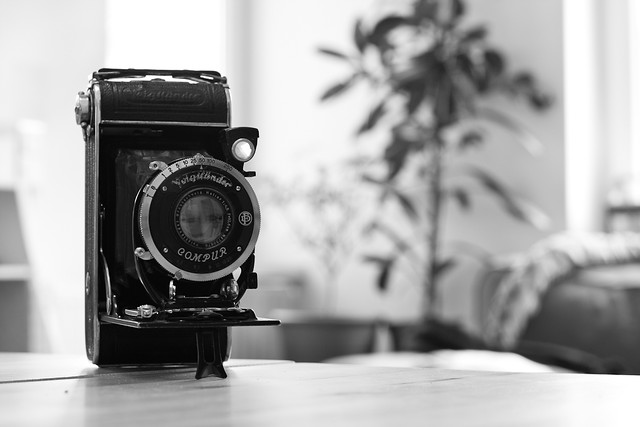
I am happy with this camera: It is hardly possible to get a larger film format (6x9 on 120 film, that is more than six times as much area as provided by a standard 35mm camera) in a package that fits into any coat pocket so nicely as this one. The folded camera is not heavier or bulkier than the average cell phone that we used to carry around by the end of the 90s. Also, being a
true Voigtländer, the quality and precision of every single component is exquisite, and its more than 70 years of various adventures are hardly noticeable when the folding bed closes nicely with a reassuring snap or the film advance key rotates as smoothly as it did in the mid thirties. And the Heliar, ah, that magical Heliar now in a much more usable package, is the whole reason why I took care of these two cameras, these almost twins that, after a long journey,
reunited again.
Voigtländer Inos I
My Voigtländer Inos I flickr set
| Maker | Voigtländer |
| Model | Inos I |
| Type | folding bed camera |
| Lens | Voigtländer Heliar 105mm f/4.5 (No. 759876, Sep 1933) |
| Shutter | Compur, rim set, size #0, 1 - 1/250 + B + T |
| Film type | 120 6x9, 4.5x6 |
| Year | 1933 |
| Country | Germany |